
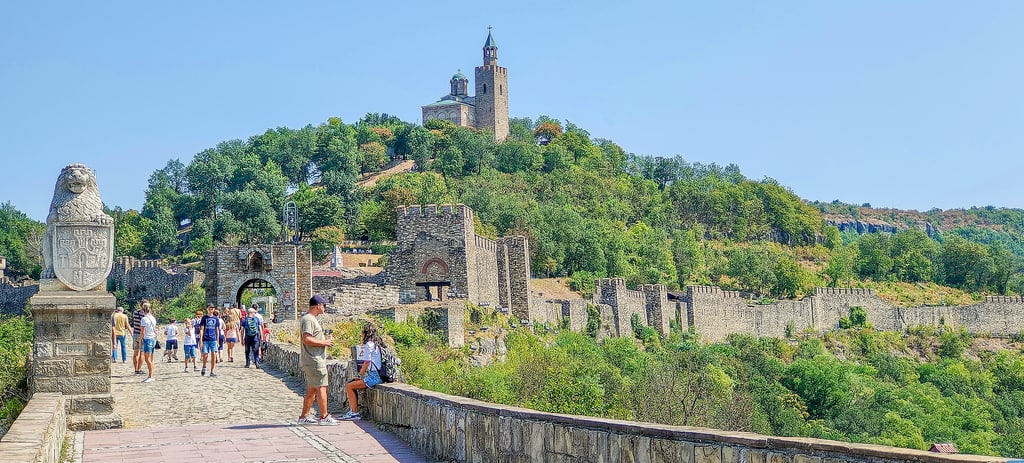
Tsarevets Fortress in Veliko Tarnovo is Bulgaria’s most famous medieval stronghold and a must-see for anyone exploring the country’s rich history. Rising high above the Yantra River, this restored citadel was once the heart of the Second Bulgarian Kingdom (12th–14th century) and the seat of the Bulgarian tsars.
This guide covers everything you need to plan your visit: how to get to Tsarevets Fortress, ticket prices, opening hours, what to see inside such as the Baldwin Tower and the Execution Rock, and practical tips for making the most of your trip. I have also included local insights from my 13 years living in Veliko Tarnovo so you can explore the fortress like a true insider.
Read more: My Veliko Tarnovo travel guide
DISCLOSURE: This post contains affiliate links. If you make a purchase via one of those links, I will earn a commission at no extra cost for you.
How to Get to Tsarevets Fortress in Veliko Tarnovo
To get to Tsarevets, you need to get first to Veliko Tarnovo. The city is easily accessible by bus from Sofia, Varna or Plovdiv and from Romania (Bucharest) and Turkey (Istanbul).
If you don’t want to bother yourself with logistics, you can join an organized tour to Veliko Tarnovo, which includes among others a tour of Tsarevets Fortress. Here is a selection of tours to Veliko Tarnovo:
- From Sofia: Veliko Tarnovo & Arbanassi 12 hrs Day Tour
- From Bucharest: Bulgaria Private Day Trip with Guide
Once in Veliko Tarnovo, you can just walk to the fortress. If you are staying outside of the city center you can take the bus. Bus lines 20, 40, 50, 110 stop nearby Tsarevets.
Going by car is not really advisable, as there aren’t sufficient parking spaces in close proximity. If you still decide to go by car, the nearest parking space is located at ul. “Kraybrezhna” 47.

Tsarevets Fortress Opening Hours & Tickets
Although you can reach the fortress, admire it from the square in front, get a few pictures and hop on your car to your next adventure, I highly recommend that you visit it. You will learn a lot about the history of this place and Veliko Tarnovo and get some pretty amazing views of the city from the top of the hill.
- Opening hours
April-September: 8:00 – 20:00
October: 9:00 – 18:00
November-March: 9:00 – 16:00
- Admission
You can buy tickets online and at the at the entrance. Price is 15 BGN (about 8 EUR). If you are still at school or a student, you pay only 6 BGN (about 3 EUR). Kids under the age of 7 can visit Tsarevets free of charge.
There are also tickets for families and for seniors. Also combination tickets for other historical sites are available.
The discounted and combination tickets are available only at the entrance.

Why is Tsarevets important
Most people don’t know that Bulgaria was one of the super powers in Europe in the Middle Ages, always questioning the dominance of the Byzantine Empire and later the Latin Empire.
The Second Bulgarian Kingdom existed between 1185 and 1396 occupying the territories on the Balkan Peninsula between the Black Sea, the Aegean Sea and the Adriatic Sea. Under the Asen Dynasty (the kings that ruled Bulgaria in those ages) Tarnovo was called the “Third Rome”, being an important hub of Medieval architecture, literature and art.
The two most significant schools of those days are the Tarnovo Artistic School and the Tarnovo Literary School. The first one set the trends in the medieval painting and the second one gave some major religious and secular literary works.

What to See Inside Tsarevets Fortress
The fortress with the surrounding ramparts has been continuously in restoration since the 1930s. The Patriarchal church, the Baldwin Tower and the two gates are completely restored today. The King’s Palace hasn’t been yet finished. During the excavations there were found on the hill 470 residential buildings, 23 churches, 4 monasteries and an inn.
The Patriarchal Church
Perched at the highest point of Tsarevets Hill, the Patriarchal Church of the Holy Ascension of God is the fortress’s most visible landmark. The original church, built in the late 12th century, served as the spiritual centre of the Second Bulgarian Kingdom (1185-1396) and the seat of the Bulgarian Orthodox Patriarch. It hosted coronations, royal weddings, and major religious ceremonies, symbolising the kingdom’s political and religious strength until its destruction after the Ottoman conquest in the 14th century.

The current building is a 20th-century reconstruction based on archaeological research. While its exterior follows the medieval design, the interior is decorated with modernist murals painted by Teofan Sokerov in the 1980s. Using dark, moody colours, the artist depicted scenes from Bulgaria’s medieval history, capturing both its glory and its downfall.
The result is striking and memorable – some visitors find it inspiring, others detest it. I personally, find the murals depressing and not suitable for the place. But as they have been there for so long, they have become part of it, I guess, as I can’t imagine the place anymore without them.
From the Patriarchal Church you have this beautiful view over the city: from there, you can see Veliko Tarnovo’s rooftops, the Yantra River, and the surrounding hills. The climb to the top is along cobblestone paths, so comfortable shoes are essential.

The Baldwin Tower and the Legend of Baldwin
The Baldwin Tower (one of the symbols of Veliko Tarnovo) stands at the southeastern corner of Tsarevets Fortress, overlooking the Yantra River and guarding one of the fortress’s main defensive points. Its name comes from a legend about Baldwin I of Flanders, the first emperor of the Latin Empire, who was captured by Tsar Kaloyan after the Battle of Adrianople in 1205.
According to the legend, Baldwin was imprisoned here until his mysterious death. Some versions say he was executed for political reasons, while others claim it was because of a romantic scandal involving the queen. Another story says that Kaloyan has made a wine goblet out of Baldwin’s skull.

Although this is one of the most famous legends of Tsarevets, historians cannot confirm that Baldwin was ever kept in this tower. The structure that stands today is a reconstruction from the 1930s, modelled after a preserved medieval tower in the village of Cherven. Its solid stone base and narrow windows give a good impression of how the original military architecture might have looked.
The Execution Rock
The Execution Rock is located on the outer edge of Tsarevets Hill, directly across from the Baldwin Tower. From this high point, there is a sheer drop down to the Yantra River. According to local legend, this was the place where traitors and enemies of the Second Bulgarian Kingdom were put to death. They were thrown from the rock into the waters below, a punishment meant to be both fatal and a warning to others.

While there is no written evidence to confirm the exact events that took place here, the site remains one of the most talked-about spots in the fortress. Standing at the edge, you can imagine the drama and fear that must have surrounded such moments. The view itself is striking, with the river winding far below and green hills stretching into the distance.
Important: There are no barriers at the Execution Rock, so visitors should take great care when approaching the edge. It is best to keep a safe distance, especially if you are taking photos.
The King’s Palace
The King’s Palace sits at the northern side of Tsarevets Hill and was the official residence of the rulers of the Second Bulgarian Kingdom. Built in the 12th century, it served not only as a home for the tsars but also as the administrative centre of the kingdom. Archaeological excavations have uncovered remnants of walls, towers, and a throne hall, giving a glimpse of the palace’s original scale and importance.

Today, the palace is partially reconstructed, allowing visitors to imagine the grandeur of medieval royal life. Stone foundations and reconstructed walls outline the original layout, while the central courtyard shows where official ceremonies and gatherings would have taken place.
The Gates
Tsarevets Fortress could once be accessed from three gates: the Main Gate, the Small Gate, and the Frankish Gate.

The Main Gate sits at the base of the hill and was the primary entrance into the stronghold. It was fitted with a drawbridge above the so-called Split Rock and was followed by 4 other gates, spaced at about 30 m from each other. From the 5 consecutive gates only 3 are restored: No. 1, 4 and 5.

The Small Gate, or the Asenova Gate, was located at the northwestern part of the wall and connected Tsarevets with Trapezitsa (the second stronghold in Medieval Tarnovo) and The New Town (the third stronghold, located on the banks of the Yantra River, between Tsarevets and Trapesitza). It was restored in the 1970s.

The third and last entry to the stronghold was via the Frankish Gate, located near the Baldwin Tower. It connected the fortress with the Frankish quarter. The Frankish Quarter was a bustling district located near the western foot of Tsarevets Hill, inhabited mainly by Western European merchants, craftsmen, and settlers from regions such as Venice, Genoa, and France. These “Franks,” as they were called by the Bulgarians, played an important role in the city’s economy, trading goods like cloth, wine, and luxury items in exchange for local products.

Tsarevets Fortress Sound and Light Show
Not only during the day is Tsarevets a tourist attraction, in the evening you can enjoy the Sound and Light show on the fortress – lasers, colourful lights and dramatic music. The show is played free of charge on bank holidays and can be enjoyed from the square in front of the fortress. You can check here the days when the show will be played, so that you can buy tickets.
Events and Festivals at Tsarevets Fortress
Tsarevets Fortress is more than a historical site. It also serves as a stage for cultural events that bring the medieval walls to life.
During the summer months, Tsarevets hosts historical reenactments where actors in medieval costumes recreate battles, royal ceremonies, and everyday life from the time of the Second Bulgarian Kingdom. The Medieval Festival takes place every year at the beginning of June.

Other cultural programs include concerts, theatre performances, and art exhibitions, held in the open-air spaces inside the fortress walls. If you are planning a visit, it is worth checking the Veliko Tarnovo tourism calendar in advance to see if your trip coincides with any of these special events.
The most popular event on Tsarevets is the summer opera festival The Stage of Ages, that’s taking place the whole summer. So, if you are visiting during the summer month for sure there will be something happening there.

Tips for Visiting Tsarevets Fortress
When visiting Tsarevets, make sure you are wearing comfortable shoes, as visiting the fortress involves some degree of hiking on cobbled pathways.
Dos
- Wear comfortable shoes, as a lot of climbing is involved and walking on paths covered with cobbled stone
- Bring a bottle of water or other refreshments with you
- If you have problems with walking, bring walking sticks
Don’ts
- Do not venture the hill on a hot summer day
- Do not carry a heavy backpack or other luggage
- Do not walk on the walls as it’s dangerous

Is Tsarevets Fortress Worth Visiting?
If you a mindful tourist that is eager to learn about the past of a country you are visiting, or you are a history geek that’s been bitten by the travel bug, Tsarevets is the perfect attraction to include on your sightseeing tour of Bulgaria.
Well, you can be none of these and I still recommend you visiting this place, as it has this special charm and uniqueness and there are some lovely views to the surrounding hills and the picturesque city of Veliko Tarnovo.

I had not heard of Tsarevets but it sounds like a interesting place. I do really enjoy learning about the countries that I visit. I love that they do a laser show on some nights.