
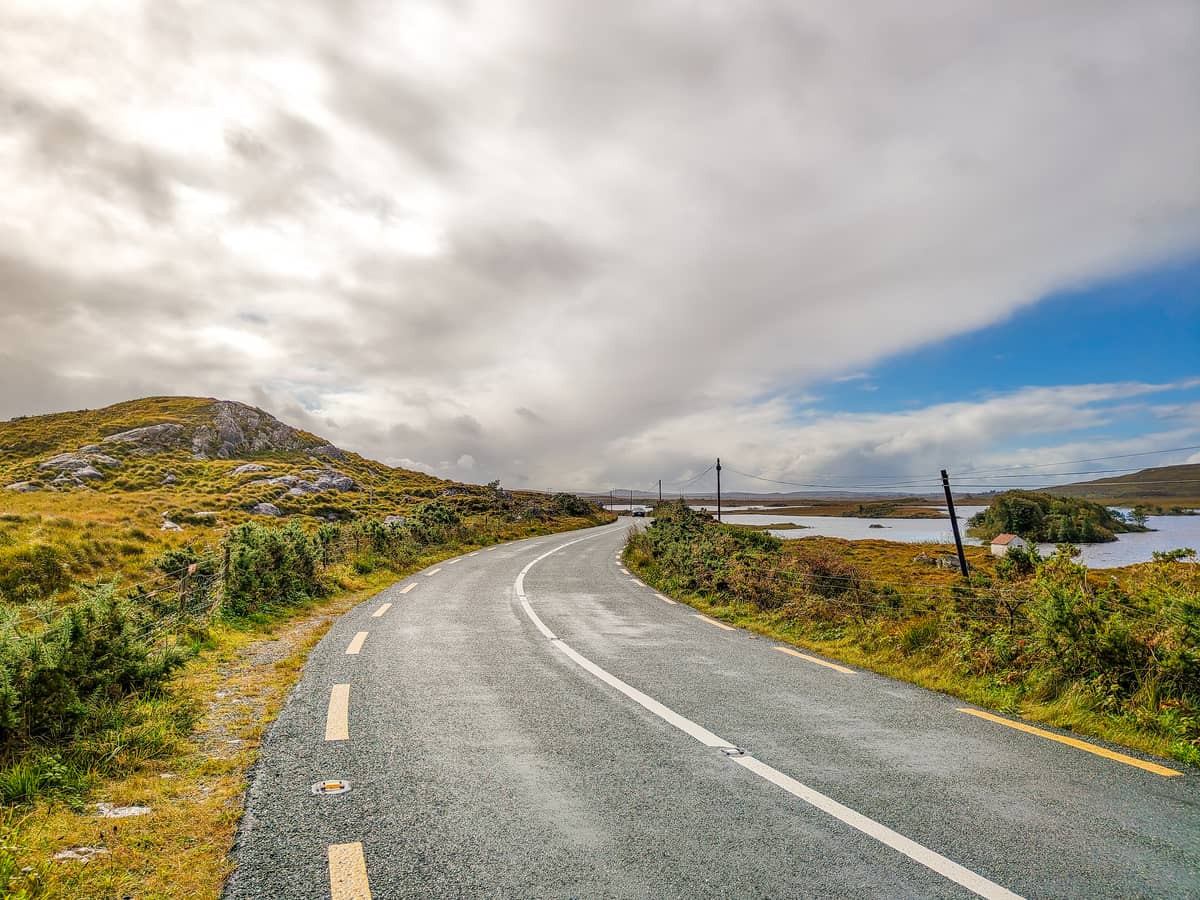
If you’re like me and prefer not to drive when visiting a country, planning a trip to Ireland without a car might seem impossible. Most itineraries assume you’ll rent a car and navigate the narrow country roads yourself. But I didn’t – and it worked perfectly. I spent 10 days traveling around Ireland without a car, and in this post I’ll show you exactly how I did it.
When you don’t drive, it’s easy to think you’re limited to the big cities. And while I do enjoy a good city trip, Ireland’s real magic lies beyond them. I wanted to see sheep causing traffic jams on winding roads, watch the Atlantic crashing against dramatic cliffs, and climb at least one of those windswept hills from The Height of Nonsense. And somehow, I managed to do all of that – including the hill – without ever renting a car.
DISCLOSURE: This post contains affiliate links. If you make a purchase via one of those links, I will earn a commission at no extra cost for you.
DISCLAIMER: The tours on Day 5 and 6 from this itinerary were hosted by Go Visit Donegal and their partners. They have provided for the transportation, the tours, the lunch and the activities. The rest of the tours, as well all hotels were paid by me. The opinions in this post, however, are mine and do not reflect the policy of my hosts.
Planning a Trip to Ireland Without a Car
Planning a trip to Ireland without a car can seem a bit challenging at first. With some research, though, it’s entirely possible. Public transport alone wouldn’t have worked for the places I wanted to see, as many of Ireland’s most beautiful landscapes are difficult to reach by bus or train. Hiring a private driver or booking private tours was well beyond my budget, so I settled on a much more practical solution: group day tours.
I had 10 days in Ireland (not counting arrival and departure days), so I chose three base locations and explored the surrounding regions on day trips. In total, I took six organized tours, had two travel days between cities, and spent two days at a conference I attended in Letterkenny. Since most travelers won’t be attending a conference like I did, the whole itinerary becomes 10 days with the arrival and departure days.
Researching Day Tours in Ireland
To explore Ireland without a car, I relied heavily on organized day tours departing from the cities where I stayed.
As I had already visited Ireland once before and explored quite a few counties in the south, I decided to focus this trip on the northern part of the country. I had a rough list of places I wanted to see, so I started searching for those destinations on GetYourGuide to check where the day tours departed from. That’s how I narrowed down my base cities to Dublin and Galway. The third base – Letterkenny – was non-negotiable, as the conference I was attending was held there.
I could have booked tours directly with local operators, but researching each provider individually would have taken far too much time, as many companies offer very similar itineraries. Instead, I decided to book everything through one platform so I could keep all reservations in one place and manage them easily.
The tours from Letterkenny were provided by the tourism board of County Donegal, but you can visit exactly the same places using public transportation. I have indicated how to do this in the summary of the respective days.
These are the exact tours I booked during my trip:
- From Galway: Aran Islands & Cliffs of Moher Full-Day Trip
- From Galway: Connemara and Kylemore Abbey Day Tour
- From Dublin: Boyne Valley with Newgrange and Bru Na Boinne Entry
- From Dublin: Celtic Boyne Valley and Ancient Sites Tour

My 10-Day Ireland Itinerary Without a Car
Exploring Ireland without a car requires a slightly different approach than the classic self-drive road trip. Instead of changing accommodation every night, I based myself in three cities – Galway, Letterkenny, and Dublin – and took day tours from each of them. This makes it much easier to reach places that are difficult to access by public transport, while still keeping travel days to a minimum.
During these ten days I explored some of Ireland’s most spectacular landscapes, including the Aran Islands, the Cliffs of Moher, Connemara, Galway, and the ancient sites of the Boyne Valley. The itinerary combines intercity bus travel with organized day tours, which turned out to be a surprisingly efficient way to see the country.
Below you can see a map of my route across Ireland, followed by a quick summary of the itinerary day by day.
Itinerary Summary
Day 1 – Arrival in Dublin and bus to Galway – stay in Galway
Day 2 – Aran Islands and the Cliffs of Moher – stay in Galway
Day 3 – Connemara and Kylemore Abbey – stay in Galway
Day 4 – Transfer to Letterkenny – stay in Letterkenny
Day 5 – Glencolmcille Folk Village – stay in Letterkenny
Day 6 – Ballyshannon – stay in Letterkenny
Day 7 – Transfer to Dublin – stay in Dublin
Day 8 – Boyne Valley with Newgrange and Brú na Bóinne – stay in Dublin
Day 9 – Celtic Boyne Valley and Ancient Sites Tour – stay in Dublin
Day 10 – Departure from Dublin
Day 1: Dublin to Galway
Distance: 215 km
Transport: CityLink bus line 760 (direct), departs from zone 11 at Terminal 1 (2 hours 30 minutes travel time)
Dinner: McDonagh’s (Galway)
Where to stay: Eyre Square View (Galway)
I booked an early afternoon flight to Dublin, which gave me enough time to travel straight on to Galway, check into my hotel, and still have a few hours to explore the city in the evening.

Getting from Dublin Airport to Galway by bus is very straightforward. I booked my ticket in advance with CityLink, whose coaches depart directly from the bus stops outside the airport. The stops are clearly marked, and I simply took Line 760 to Galway.
My first impression of Galway? Colour everywhere. Brightly painted houses, lively pubs, and a young, energetic atmosphere thanks to the large student population. With around 70,000 residents and more than 300 pubs, it’s easy to see why the city has such a reputation for nightlife – though that also means plenty of stag and hen parties roaming the streets.

For dinner I stopped at McDonagh’s, a well-known seafood restaurant that turned out to be a favourite with locals. After a long travel day, fresh fish and a walk through Galway’s lively streets felt like the perfect start to the trip.
Day 2: Aran Islands and the Cliffs of Moher
Tour: From Galway: Aran Islands & Cliffs of Moher Full-Day Trip
Tour highlights include: Corkscrew Road, Doolin Pier, Inisheer, Plassey shipwreck, Cliffs of Moher, The Burren, Wild Atlantic Way, Fanore
Lunch: Flaherty’s Bar at Inis Oírr Hotel, Inisheer
Dinner: The Quays Bar and Restaurant (Galway)
Where to stay: Eyre Square View (Galway)
The second day of my Ireland itinerary without a car was dedicated to one of the most famous landscapes on the west coast: the Aran Islands and the Cliffs of Moher.
Our tour first took us along the winding Corkscrew Road through the limestone landscape of the Burren to Doolin Pier, where we boarded the ferry to Inisheer, the smallest of the Aran Islands.

Inisheer is tiny but full of character. Dry-stone walls crisscross the island, colourful houses dot the fields, and the ruins of O’Brien’s Castle sit on a hill overlooking the Atlantic. About 300 people live here in the winter months, and despite its size the island even has a small airport – local children sometimes fly to school on the mainland when the weather allows.

The weather during my visit was anything but calm. The wind was so strong near the famous Plassey shipwreck that I was almost knocked off my feet. After battling the elements for a while, I retreated to a cosy pub for a bowl of chowder and a well-earned beer.

On the return journey, the ferry sailed directly beneath the Cliffs of Moher, offering an incredible perspective of the towering cliffs from the sea before we visited them again from the top at the Cliffs of Moher Visitor Centre.

The drive back to Galway continued through the dramatic landscape of the Burren, part of the Burren and Cliffs of Moher UNESCO Global Geopark, before joining the coastal Wild Atlantic Way. The rain was relentless, so photography from the bus was out of the question – especially since I had managed to sit on the wrong side of the coach.

Thankfully, the day ended on a warmer note with a stop at O’Donohue’s Pub in Fanore for a glass of Irish whiskey before returning to Galway.
Book this tour:
Tip: If you’re planning a similar trip, I’ve compared all the best day tours from Galway – both to the Cliffs of Moher and Connemara – so you can see exactly which one fits your itinerary best.

Back in Galway in the early evening, I spent some more time wandering through the city centre. I browsed a couple of small bookshops and stopped by a few historic sights along the way, including the remains of the Hall of the Red Earl and the Browne Doorway.
Day 3: Connemara and Kylemore Abbey
Tour: From Galway: Connemara and Kylemore Abbey Day Tour
Tour highlights include: Connemara, Pine Island, Twelve Bens, Clifden, Sky Road, Kylemore Abbey, Lough Inagh
Lunch: Kylemore Abbey
Dinner: Gemelle’s (Galway)
Where to stay: Eyre Square View (Galway)
Day three took me into Connemara, one of the wildest and most beautiful regions in western Ireland.

The tour included several scenic stops along the way, including the Pine Island viewpoint, where the dramatic Twelve Bens (or Twelve Pins) mountain range rises in the background.

We also stopped in Clifden, the small coastal town often considered the capital of Connemara. Founded in the 19th century, it’s known today for the nearby landing site of the first non-stop transatlantic flight in 1919 and for its famous Connemara pony fair.

One of the highlights of the drive was the Sky Road, a narrow coastal route with sweeping views over the Atlantic. Our driver described it as a glimpse of “hidden Ireland”, and it certainly felt that way as we navigated tiny roads lined with fuchsia bushes.

The main stop of the day was Kylemore Abbey, a romantic 19th-century castle built by Henry Mitchell for his wife Margaret after she fell in love with Connemara during their honeymoon. Today the estate is home to Benedictine nuns, and visitors can explore the abbey, the small neo-Gothic church, and the beautifully restored Victorian walled garden.

On the way back to Galway we stopped at Lough Inagh, where the evening light illuminated the Twelve Bens – and where a group of very friendly sheep happily accepted snacks and attention from passing visitors.
Book this tour:

Back in Galway, the rain had finally cleared, so I took a walk along the waterfront in Claddagh, the city’s historic fishing village, before ending the evening with what might be the perfect Irish pairing: fresh oysters and a pint of Guinness.
Day 4: Galway to Letterkenny
Distance: 250 km
Transport: Expressway 64 to Derry, departs from Galway Bus Station on Station rd, not Galway Coach Station (about 5 hours travel time)
Dinner: Yellow Pepper (Letterkenny)
Where to stay: McGettigan’s Hotel (Letterkenny)
On the fourth day I left Galway and headed north to Letterkenny in County Donegal. With the sun finally shining, I took one last walk through Galway’s colourful streets before boarding the coach for the journey.

Pro tip: Galway has two different bus stations. Check from which one your bus departs well in advance!
One thing to keep in mind when traveling by bus in Ireland without a car: Galway actually has two different bus stations. The CityLink buses from Dublin arrive at one location, while the Expressway buses to Donegal and Letterkenny depart from another. The two stations are fairly close to each other, but if you arrive at the wrong one – as I did – you’ll need a bit of extra time to find the other.
The bus ride from Galway to Letterkenny takes about five hours, crossing some beautiful countryside along the way. After checking into my hotel, I set out to explore the town. Letterkenny’s centre is fairly small, so you can easily walk through most of it in a couple of hours.

Just as I was wandering down the main street taking photos, the weather turned – suddenly it started pouring with rain. Instead of wrestling with my rain poncho, I spotted Cottage Bar across the street and decided that stepping inside for a Guinness was a much better solution.

When the rain eased, I headed a few doors down to Yellow Pepper for dinner, where I ended up sharing a table with a friendly couple from Australia and swapping travel stories. Later that evening I stopped by Blake’s Bar, where a local band was playing traditional Irish music. I met up with friends from the TBEX conference, and by the time I walked back to my hotel close to midnight, the rain had cleared and a full moon was shining over the town.
Day 5: Glencolmcille Folk Village
Highlights: Glencolmcille, Rusty Mackerel
Public transport option: Line 991 operated by McGeehan Coaches
Dinner: Warehouse Bar & Kitchen (Letterkenny)
Where to stay: McGettigan’s Hotel (Letterkenny)
On the fifth day I joined a tour to Glencolmcille (Glencolumbkille), a small coastal village in County Donegal known for its strong Irish cultural traditions.
Located along the Wild Atlantic Way, Glencolmcille sits between rugged cliffs and open Atlantic landscapes. The village is part of the Gaeltacht, meaning Irish (Gaeilge) is still spoken here as an everyday language.

Our visit began with a short introduction to the Irish language – my first proper lesson in Gaeilge – before exploring the Glencolmcille Folk Village, an open-air museum that recreates traditional life in rural Donegal during the 18th, 19th, and early 20th centuries. We watched demonstrations of local crafts and listened to stories about how people lived in this remote part of Ireland.

The scenery around the village was just as memorable as the cultural experience: dramatic coastline, green hills, and of course the ever-present Donegal weather.

The day ended at the famous Rusty Mackerel, a legendary pub near the cliffs. By pure luck, musicians Steve Cooney and Dermot Byrne were playing a live trad session – something that felt like a very special treat.
Back in Letterkenny that evening, I continued the night with what had by then become a familiar routine in Ireland: hopping between pubs, meeting fellow travelers, and listening to more great traditional music.
Day 6: Ballyshannon Village
Highlights: Ballyshannon, Donegal Brewing, Donegal County Museum and Letterkenny Town park
Public transport option: Expressway 64
Dinner: McGinleys Bar (Letterkenny)
Where to stay: McGettigan’s Hotel (Letterkenny)
The sixth day started with what seemed to be the most important activity of the morning: beer tasting. Little did I know that it would soon be followed by whiskey tasting – a rather ambitious start to the day.

I was once again on a tour organized during the TBEX conference, this time heading to Ballyshannon, often described as Ireland’s oldest town based on archaeological findings in the area. By this point in the trip, Guinness, beer, and whiskey had become regular companions. Among conference participants the running joke was that it was always time for “the daily Guinness.” In reality, it was rarely just one.

Ballyshannon itself has an interesting history. The town is best known as the birthplace of legendary blues guitarist Rory Gallagher, whose statue stands proudly in the centre and whose story is featured in the local museum. But the town also has connections to a surprisingly eclectic group of famous names: Mary Shelley, author of Frankenstein, whose grandmother lived there, Bram Stoker, creator of Dracula, whose mother was born there – and even Tony Blair, who did write nothing but spent part of his childhood in the town before eventually ending up at 10 Downing Street.

During the visit, a passionate local historian shared some of the darker chapters of the town’s past – stories of poverty after the Great Hunger, emigration, and even a mysterious mass grave discovered in the area.
Unfortunately, the Donegal weather had other plans. As the rain kept pouring down, we eventually abandoned the walking tour and headed back to Letterkenny.

Back in town, I took some time to explore the Donegal County Museum, which tells the story of the region through archaeological finds, historical artefacts, and exhibitions about Donegal’s role in Irish history. Afterwards, I walked through the nearby Letterkenny Town Park – a nice way to end the day after all the rain.
Day 7: Letterkenny to Dublin
Distance: 240 km
Transport: Expressway 32 (about 4 hours 30 minutes travel time)
Dinner: Sprout & Co (Dublin)
Where to stay: Harcourt Hotel (Dublin)
On day seven it was time to leave Letterkenny and head back to Dublin. Before catching the bus, I stopped one last time at the corner café, The Quiet Moment Tearooms, for a small breakfast. Around me, everyone seemed to be tackling a full Irish breakfast – an impressive mountain of food that I honestly couldn’t imagine finishing that early in the morning.

As the rain started again, I grabbed a taxi to the bus station for the journey south. The route is operated by Expressway Line 32, and the bus ride from Letterkenny to Dublin takes around four to five hours.
Tip: The route briefly crosses into Northern Ireland (United Kingdom) before returning to the Republic of Ireland, so depending on your nationality you may need to check whether the UK Electronic Travel Authorisation (ETA) applies to you. I arranged mine in advance through the official website – the process was quick and straightforward – although in our case the bus was never stopped for checks along the way.

Luckily, many fellow TBEX conference attendees were on the same bus, so the long ride passed quickly with plenty of conversation and laughter.
After arriving in Dublin, I took a taxi to my hotel. My plan had been to head straight out and explore the city, but travel fatigue won – I opted for a short siesta instead. When I woke up in the evening, I found a nearby spot for dinner, Sprout & Co, which turned out to be a great place for a quick and healthy meal.
I finished the day in the hotel bar with what had by now become a daily ritual: a pint of Guinness. The hotel’s location was excellent, but if you’re planning to stay there, make sure you’re not a light sleeper.
Day 8: Boyne Valley with Newgrange and Brú na Bóinne
Tour: From Dublin: Boyne Valley with Newgrange and Bru Na Boinne Entry
Tour highlights include: Boyne Valley, Brú na Bóinne Visitor Centre, Knowth, Newgrange, Mellifont Abbey, Monasterboice
Lunch: Brú na Bóinne Visitor Centre
Evening: Trinity College, Temple Bar, River Liffey (Dublin)
Dinner: no suggestion as there are too many lovely places
Where to stay: Harcourt Hotel (Dublin)
Day eight took me to the Boyne Valley, one of the most fascinating historic regions in Ireland. This was my first proper introduction to Ireland’s passage tombs – prehistoric stone monuments built more than 5,000 years ago, many of them decorated with megalithic carvings and aligned with the sun.

The day started early in Dublin with breakfast near the Molly Malone statue, where my tour departed. Our first stop was the Brú na Bóinne Visitor Centre, which gives a helpful introduction to the UNESCO-listed archaeological landscape before visitors continue on to the sites themselves.

We first visited Knowth, a vast passage tomb complex surrounded by carved kerbstones. Even without knowing much about it in advance, I found it deeply impressive – both for its age and for the mysterious symbolism carved into the stones.

The highlight of the day was Newgrange, the most famous of the Boyne Valley monuments. Walking through the narrow passage into the inner chamber was an unforgettable experience, made even more fascinating by the demonstration showing how sunlight enters the tomb at a specific time of year.

The tour also included stops at Mellifont Abbey, the ruins of Ireland’s first Cistercian monastery, and Monasterboice, best known for its beautifully carved high crosses and round tower. By then the weather was doing what Irish weather does best – rain, wind, a brief hint of sunshine, and then rain again.

Book this tour:
Back in Dublin that evening, I took advantage of the clearer skies and wandered through the city centre, around Trinity College, Temple Bar, and along the River Liffey. After a day spent among prehistoric tombs and medieval ruins, Dublin suddenly felt much livelier – and much louder.

Day 9: Celtic Boyne Valley and Ancient Sites Tour
Tour: From Dublin: Celtic Boyne Valley and Ancient Sites Tour
Tour highlights include: Hill of Tara, Trim Castle, Loughcrew, Sliabh na Caillí, Fore Distillery, Fore Abbey
Lunch: Fore Distillery
Evening: Book of Kells, Dublin Castle, Christ Church Cathedral (Dublin)
Dinner: no suggestion as there are too many lovely places
Where to stay: Harcourt Hotel (Dublin)
My second day of touring from Dublin focused on the historic sites of the Boyne Valley and the surrounding countryside.

The first stop was the Hill of Tara, one of the most sacred places in Irish history. For centuries it served as the ceremonial seat of the High Kings of Ireland, and standing there it’s easy to imagine how important this hill once was. Fans of Gone with the Wind might recognise the name – Scarlett O’Hara’s plantation was named after this very place.

Next we visited Trim Castle, the largest Norman castle in Ireland and a filming location for the movie Braveheart. It may look like a Scottish fortress on screen, but it is very much Irish.

The most memorable stop of the day was Loughcrew, another prehistoric passage tomb complex. Reaching the tombs requires climbing a steep hill that also happens to be Slieve na Calliagh (Sliabh na Caillí) – the highest point in County Meath. As I struggled up the hill in strong wind and rain, I suddenly had a déjà vu moment: it felt exactly like the book The Height of Nonsense, about a man climbing the highest point in every Irish county. Without planning it, I had just conquered one of them.

From there we continued to the tiny village of Fore. Before visiting the abbey, we stopped at the nearby Fore Distillery, where we had lunch and a tasting of local spirits. The distillery produces traditional Irish poitín, once an illegal homemade spirit, as well as whiskey and liqueurs. During the tasting we learned how poitín is made and how it differs from vodka, and I even bought a small bottle to continue my “research” once I got back home.

Afterwards we explored the village itself, home to the ruins of the 7th-century Benedictine Fore Abbey and the legend of the Seven Wonders of Fore. With just a couple of pubs, a café, and a handful of houses, it’s a charming place to pause before heading back to Dublin.
Book this tour:

Back in the city that evening, I visited Trinity College to see the famous Book of Kells and its spectacular Long Room library, before walking through the centre past Dublin Castle and Christ Church Cathedral. I ended the day at Porters Pub, enjoying their buffalo wings with a well-earned pint.
Day 10: Dublin
Highlights include: National Gallery of Ireland, Marrion Square Park, St. Stepgen’s Green, Iveagh Gardens
Breakfast: National Gallery of Ireland (Dublin)
On my last morning in Dublin, I took a short walk through a few nearby gardens on the way to the National Gallery of Ireland. It felt like the perfect final stop before leaving the city.

The gallery turned out to be a great choice. Its collection spans centuries of European art, and walking through the rooms feels almost like a quick lesson in art history. With limited time before my flight, I wandered through the galleries somewhat randomly, trying to see as much as possible.

I was especially excited to see one of Johannes Vermeer’s paintings, Lady Writing a Letter with Her Maid. Unfortunately, when I arrived the room was partially closed because staff were installing another artwork. Still, I managed to catch a glimpse of it – which counts. I’m not really a bucket-list person, but I do have one quiet ambition: to see every Vermeer painting in person one day.
And with that, it was time to say goodbye.
Slán le hÉirinn – goodbye Ireland.
But I have a feeling I’ll be back.
How Much Does a 10-Day Trip to Ireland Without a Car Cost?
Below is a breakdown of what I spent on transportation, accommodation, and day tours during this 10-day itinerary in Ireland without a car. Food, drinks, and other personal expenses are not included in the estimate.
The two tours I took while staying in Letterkenny were organized by the Donegal Tourism Board, so they are not included in the total cost.
During the trip I stayed mostly in mid-range hotels, so depending on your travel style –budget hostels or higher-end hotels – your total cost may be lower or higher than mine.
The table below shows the approximate costs for the main travel expenses for 1 person.
| Tour 1 from Galway | 75 EUR |
| Tour 2 from Galway | 55 EUR |
| Tour 3 from Dublin | 85 EUR |
| Tour 4 from Dublin | 65 EUR |
| Hotel Galway 3 nights | 460 EUR |
| Hotel Letterkenny 3 nights | 350 EUR |
| Hotel Dublin 3 nights | 577 EUR |
| Bus ticket Dublin-Galway | 24 EUR |
| Bus ticket Galway-Letterkenny | 28 EUR |
| Bus ticket Letterkenny-Dublin | 28 EUR |
| Total | 1747 EUR |
Tips for Traveling Ireland Without a Car
Traveling Ireland without a car is absolutely possible, but it does require a bit more planning than a typical self-drive itinerary. After spending 10 days exploring the country using buses and organized day tours, here are a few practical tips that made the trip much easier.
- Choose your base cities carefully
Instead of changing hotels every night, stay in cities where many tours depart. Places like Galway and Dublin are excellent bases for day trips to famous destinations such as the Cliffs of Moher, Connemara, and the Boyne Valley.
- Use day tours to reach remote places
Public transport connects the main cities quite well, but many of Ireland’s most spectacular landscapes are difficult to reach without a car. Organized day tours are often the easiest way to visit places like the Aran Islands, Connemara, or ancient passage tombs.
- Book intercity buses in advance
Companies like CityLink and Expressway operate comfortable buses between major destinations. Booking tickets in advance can save money and guarantee a seat, especially during the busy summer months.
- Check bus stations carefully
Some cities have more than one bus station. For example, Galway has separate departure points for CityLink and Expressway buses, which can be confusing if you don’t plan ahead.
- Allow extra time for connections
Traveling without a car means relying on bus schedules and tour departure times. Give yourself a bit of buffer time between connections to avoid unnecessary stress.
- Prepare for unpredictable weather
Irish weather changes quickly. Rain, wind, and sunshine can all happen within a few hours, so a rain jacket and good walking shoes are essential.
- Book popular attractions in advance
Some places – such as the Book of Kells in Dublin or tours to Newgrange – can sell out quickly, especially in high season.
Final Thoughts
Traveling in Ireland without a car might seem complicated at first, but as this itinerary shows, it’s entirely possible with a bit of planning. By combining intercity buses and organized day tours, you can still experience many of Ireland’s most spectacular places – from the Cliffs of Moher and Connemara to the ancient sites of the Boyne Valley – without ever getting behind the wheel.
