
When you start planning a trip to Bergamo, you’ll quickly realise that the biggest decisions aren’t about which attractions to visit. They’re about where to stay, how many days to spend in the city, whether to take a day trip to Lake Iseo, and whether it’s worth planning every detail in advance. Those choices will shape your trip far more than deciding which museum to visit first.
The recommendations below are based on my own four-night trip to Bergamo. They reflect the decisions that had the biggest impact on my experience, together with the alternatives, trade-offs and practical considerations to help you decide what will work best for your own trip.
DISCLOSURE: This post contains affiliate links. If you make a purchase via one of those links, I will earn a commission at no extra cost for you.

1. Stay in Città Alta or Città Bassa
Choosing where to stay is probably the most important decision you’ll make before your trip to Bergamo. Both areas offer a completely different experience, and your choice will influence how you move around the city, how much time you spend sightseeing and even how your days begin and end.
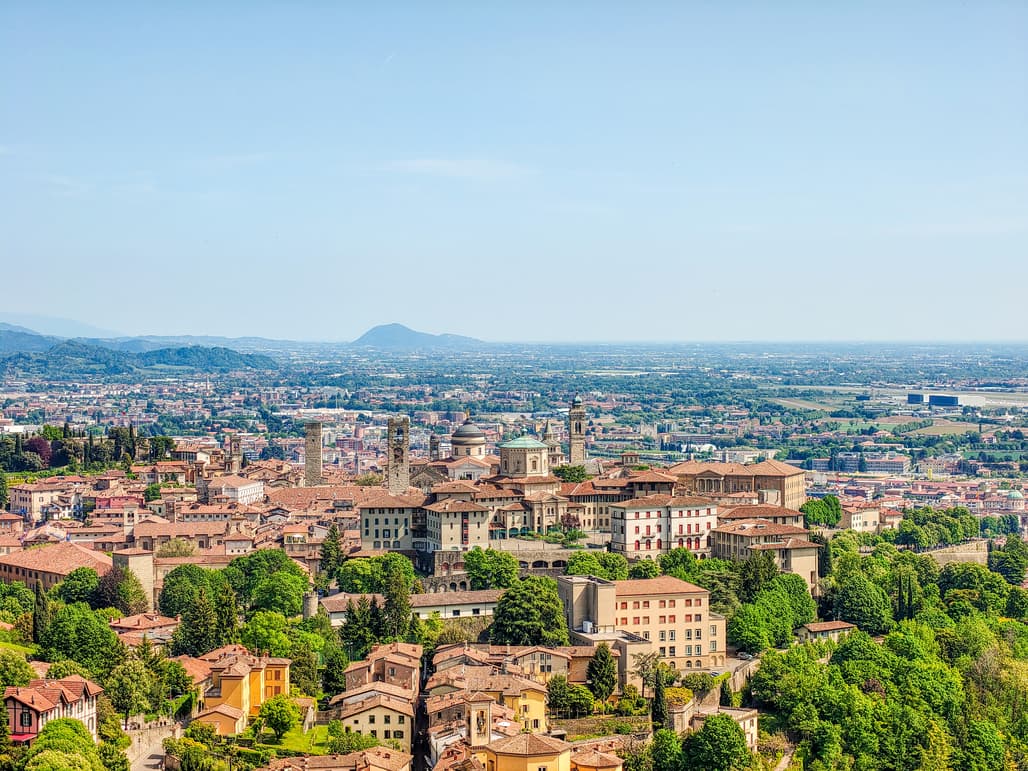
Città Alta is Bergamo’s historic Upper Town. It’s where you’ll find the medieval streets, Piazza Vecchia, the Basilica of Santa Maria Maggiore and many of the city’s best-known landmarks. Staying here means waking up in the heart of Bergamo’s most atmospheric neighbourhood and having the city’s main sights on your doorstep.

Città Bassa, the Lower Town, has a completely different feel. It’s flatter, well connected by public transport and makes a practical base for exploring both parts of the city. Rather than staying inside the medieval walls, you’ll experience a more local side of Bergamo while still being only a short bus ride or walk from Città Alta.

Transport is another factor worth considering before you book. Line 1 connects Bergamo Airport with both Città Bassa and Città Alta, but it doesn’t take you into the heart of the Upper Town. The bus stops outside the Venetian walls, so if you’re staying in Città Alta you’ll almost certainly have to walk the final stretch with your luggage over cobbled streets and uphill. During your stay, the same bus connects Città Bassa with Città Alta, making it an easy way to travel between the two. The funicular is part of the Bergamo experience and well worth taking at least once, but queues can become long during busy periods. If that happens, you can either wait, walk uphill or simply take Line 1 instead.

For me, Città Bassa was the clear choice. I wanted to explore both parts of Bergamo without worrying about luggage on arrival, steep walks or waiting for the funicular every time I returned to my accommodation. Staying in the Lower Town gave me the freedom to move around easily while still spending as much time as I wanted in the historic centre.
If your priority is staying within Bergamo’s medieval walls, Città Alta will undoubtedly appeal to you. But if you’re looking for a comfortable base with straightforward transport connections and the flexibility to experience both sides of the city with ease, I’d recommend Città Bassa.
2. Taxi or Airport Bus
One of Bergamo’s biggest advantages is how easy it is to reach the city from the airport. Unless you’re arriving very late at night, travelling with young children or carrying a lot of luggage, I’d think twice before paying for a taxi.
The easiest option is Line 1 of Bergamo’s city bus. It leaves from the bus stop just outside the arrivals hall. Buses run approximately every 20 minutes and connect the airport with both Città Bassa and Città Alta.

Buying a ticket couldn’t be much simpler. Just tap your contactless debit or credit card, or your smartphone, when you board the bus. If you’re travelling with other people, you can tap multiple times to buy up to 4 tickets with the same card or device. There are ticket vending machines at the airport, but unless you prefer a paper ticket, there’s little reason to use them.
If you’re staying in Città Bassa, the airport bus will usually get you close to your accommodation. If you’re staying in Città Alta, the same bus continues uphill, but it stops outside the Venetian walls. Since most of the Upper Town is car-free, you’ll still need to walk the final stretch to your accommodation.
After using the airport bus in both directions, I never felt I needed a taxi. It was straightforward, inexpensive and reliable.
3. Book Restaurants or Wander
Some travellers like knowing exactly where they’ll eat every evening. Others prefer deciding on the spot. Bergamo works well for both approaches, but unless there’s a restaurant you really don’t want to miss or you’re visiting during a particularly busy period, I’d keep your plans flexible.

I never booked a single restaurant before arriving in Bergamo. Instead, I decided where to eat based on where I happened to be, what looked inviting and, sometimes, what was on the menu outside. That suited the rhythm of the trip. Some evenings I stayed in Città Alta, while on others I returned to Città Bassa. I wasn’t tied to a reservation, so I could simply enjoy the atmosphere of whichever neighbourhood I was in and change my plans whenever I wanted.

That approach never felt limiting. Quite the opposite. It gave me the chance to experience the different character of Bergamo’s neighbourhoods instead of rushing to a restaurant I’d chosen weeks earlier. One thing I would recommend is ordering casoncelli alla Bergamasca, the city’s signature stuffed pasta. You’ll find it on menus throughout Bergamo, and it’s one local speciality that’s well worth trying.
4. Can I Do a DIY Day Trip from Bergamo
If you’re spending three or four days in Bergamo, I’d definitely set aside one day for a day trip. If you don’t have a car, you’ll quickly discover that there are no organised day tours departing from Bergamo. That leaves you with one option: planning the trip yourself. The good news is that it’s much easier than it might seem.

Lake Iseo was my choice, but it’s far from the only option. Bergamo is well connected by both bus and train, making it easy to explore the surrounding area on your own. Brescia is less than an hour away by train, while buses from Bergamo also take you to places like Clusone, with its beautiful historic centre, San Pellegrino Terme, famous for its Liberty-style architecture and historic spa, and the towns around Lake Iseo.

If you’re visiting Lake Iseo for the first time, I’d head to Lovere. Arriva’s Line C from Bergamo Bus Station takes you to one of Italy’s Most Beautiful Villages (I Borghi più Belli d’Italia), with its historic centre, lakeside promenade and regular ferry connections to other towns around the lake. Line E, also departing from Bergamo Bus Station, goes to Sarnico on the southern tip of the lake.
One lesson I learned was to check bus and ferry timetables carefully before setting off, especially if you’re travelling on a Sunday or public holiday, as services may operate on a different schedule. And if you’d like to experience Lake Iseo from the water, you can also prebook a boat tour departing from Lovere.
5. Is the Second Funicular to San Vigilio Worth It
What many people don’t realise when planning a trip to Bergamo is that there’s a second funicular connecting Città Alta with San Vigilio.

The ride from Città Alta to San Vigilio takes just a few minutes, but it gives you a completely different perspective on Bergamo. At the top, you’ll find the ruins of Castello di San Vigilio, walking paths and panoramic views over the city and the surrounding countryside. The busy city disappears and you are left surrounded by green and the mountains.

So yes, the second funicular to San Vigilio is absolutely worth it.
6. Prebook any Attractions in Bergamo
The best part about Bergamo is that you don’t have to plan every attraction in advance. You can simply explore the city as you go. You notice an open door, step inside and discover somewhere unexpected. That’s exactly how I ended up visiting Palazzo Moroni and its secret gardens, which turned out to be one of my favourite museums in Bergamo.

You can enjoy Bergamo without sticking to a tight schedule. That gives you the freedom to explore the city at your own pace and leave room for unexpected discoveries or recommendations from locals.

One thing that you should check in advance is the opening times. For example, The Tower of the Fallen (Torre dei Caduti) is open only on Saturdays and Sunday, Moroni Palace and Gardens (Palazzo Moroni) are closed on Mondays and Wednesdays, and Carrara Academy (Accademia Carrara) is closed on Tuesdays.
7. Aperitivo or Dinner
My answer? Both.
If you’ve never experienced an Italian aperitivo before, it’s easy to think it’s just a drink before dinner. In reality, it’s much more than that. You order a drink and it’s served with a selection of small bites, which can range from a few snacks to a generous buffet, depending on where you go. If you’re still hungry, you can always order something extra from the aperitivo menu.

For me, aperitivo quickly became part of the rhythm of the day. After a day of walking around Bergamo, it was the perfect moment to slow down, find a terrace and watch the city go by before heading out for dinner. It wasn’t about replacing a meal. It was about enjoying one of those everyday Italian traditions that makes being in Italy feel different.

So don’t choose between aperitivo and dinner. Do both. Just leave enough time to enjoy them. And one more thing: have your aperitivo in one square, then wander somewhere else for dinner. It’s a lovely way to experience different corners of the city in a single evening.
8. How Long to Stay in Bergamo
How long you stay in Bergamo will shape your trip more than almost any other decision. If you only have one day, it’s still worth coming. You’ll have enough time to explore Città Alta and get a feel for the city.

And it’s not only about the sightseeing. Staying three or four days gives you the chance to experience Bergamo properly. You’ll see the city wake up in the morning, enjoy long evenings after the day-trippers have left and have the freedom to change your plans if something catches your attention.
A longer stay also means you can dedicate a full day to exploring beyond Bergamo without feeling you’ve had to compromise on the city itself. That’s much harder to do if you’re only spending a day or two in the city.
9. Spend an Evening at Teatro Donizetti
When planning a city trip, most of us don’t think about booking a concert or a performance. Bergamo is one of the few cities where I’d make an exception.

You’ll come across Gaetano Donizetti’s name throughout Bergamo. You can even visit the house where he was born, now a museum. But spending an evening at Teatro Donizetti lets you experience that part of Bergamo’s identity rather than simply read about it. If there’s a concert, opera, ballet or another performance during your stay, I’d seriously consider going.

I chose to spend one of my evenings at Teatro Donizetti, and I’m glad I did. Dinner beforehand and drinks afterwards made it feel like a complete evening out rather than something separate from the trip. It gave me an experience in Bergamo I wouldn’t have had otherwise.
Final Words
Planning a trip always means making choices. My hope is that these nine decisions help you plan your time in Bergamo with more confidence, make informed choices and focus on the experience you want to have.
Want to know how these decisions came together during my trip? I’ve written about the unexpected moments, conversations and discoveries in Beyond the Guidebook: A Different Way to Experience Bergamo.
