

From a fishing village to a posh seaside resort, Scheveningen has gone through a transformation that has led to the creation of new attractions. However, if you go beyond the beach, you will discover that Scheveningen is a place with amazing cultural and historical heritage that makes it worthwhile to visit.
DISCLOSURE: This post contains affiliate links. If you make a purchase via one of those links, I will earn a commission at no extra cost for you.
I have visited two of the attractions in Scheveningen: SkyView De Pier and Foodhall on a press trip as a guest of the Tourism Bureau of The Hague – The Hague & Partners. The rest of the attractions I have visited on my own. The opinions in this post, however, are mine and do not reflect the policy of my hosts.
Scheveningen vs. The Hague
I have always thought that Scheveningen was a separate town from The Hague, but it turned out that it is actually a neighborhood in The Hague. Once it used to be a village, so there’s still the Village of Scheveningen (Scheveningen-Dorp or Oud-Scheveningen), which is a part of the broader place Scheveningen, that includes now the whole seaside resort.
So, if you search for attractions and things to do in The Hague you will certainly stumble upon a few sights and attractions in Scheveningen, and the other way around. I do think that Scheveningen deserves some extra attention as a destination itself because of the rich cultural and historical heritage.
Scheveningen has its own regional folk costume and regional dialect. Unfortunately, folklore traditions in the Netherlands are as good as dead (but that’s another topic) and can be seen only in museums and at a few selected places. And Scheveningen is one such a place.
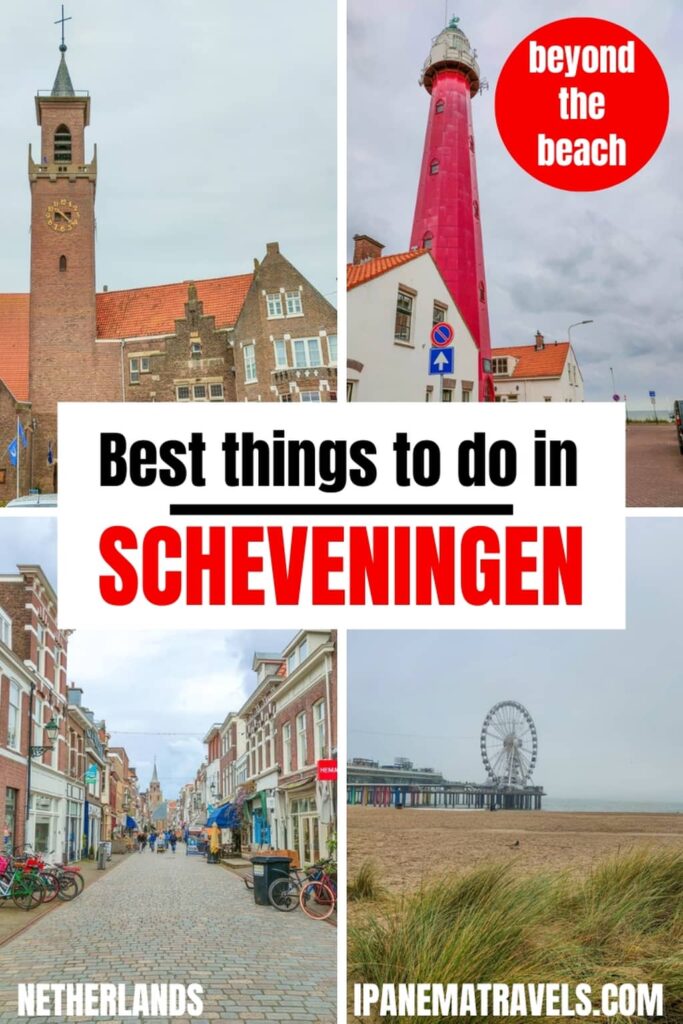
What to do in Scheveningen, besides the beach?
Here you will find a selection of attractions in Scheveningen that are open all year round. And no, I have not included anything that includes the beach or the sea, although you can’t think Scheveningen away from the sea as the place is connected tightly to it, geographically, historically and culturally.

1. Learn about Scheveningen in Muzee Scheveningen
If you want to learn about the history of Scheveningen and the fishermen’s village it once was, there is no better place to start your explorations in Scheveningen than in the local museum Muzee Scheveningen. Located in a historical school building from 1877, this museum tell the story of Scheveningen: how from a small fishermen’s village it became one of the most famous Dutch seaside resort.
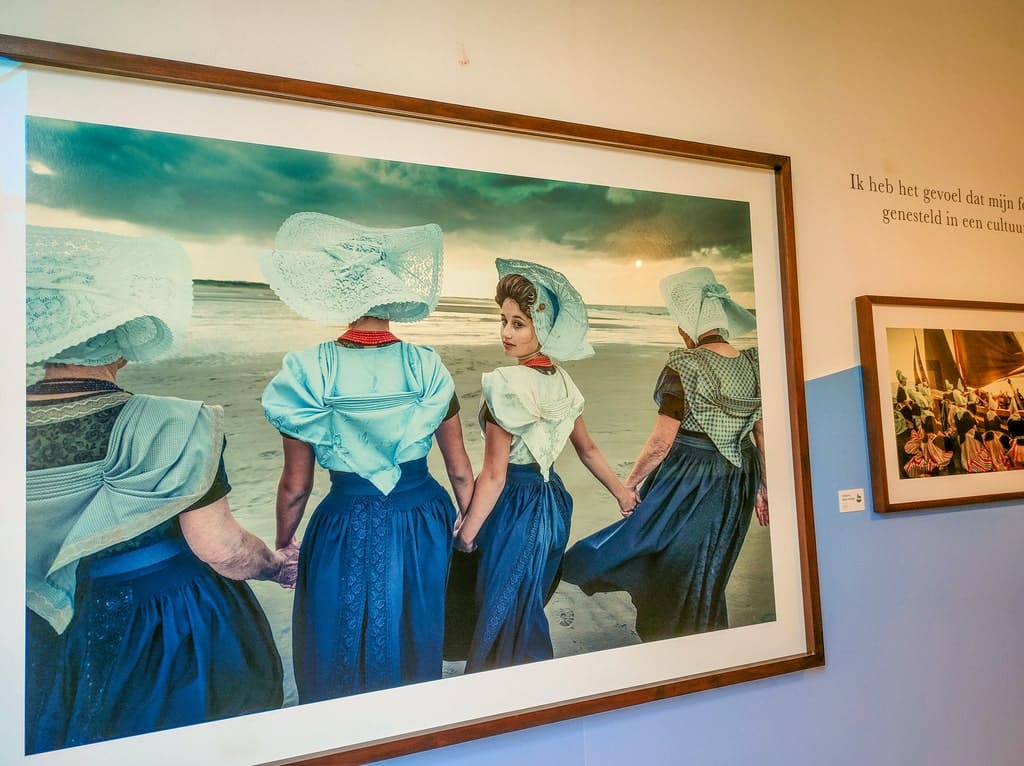
Regularly there are temporary exhibitions in the museum. When I visited the museum I was lucky to see the amazing exhibition of the world-famous photographer Jimmy Nelson – Ode to Netherlands, featuring the photographs from his book Between the Sea and the Sky.
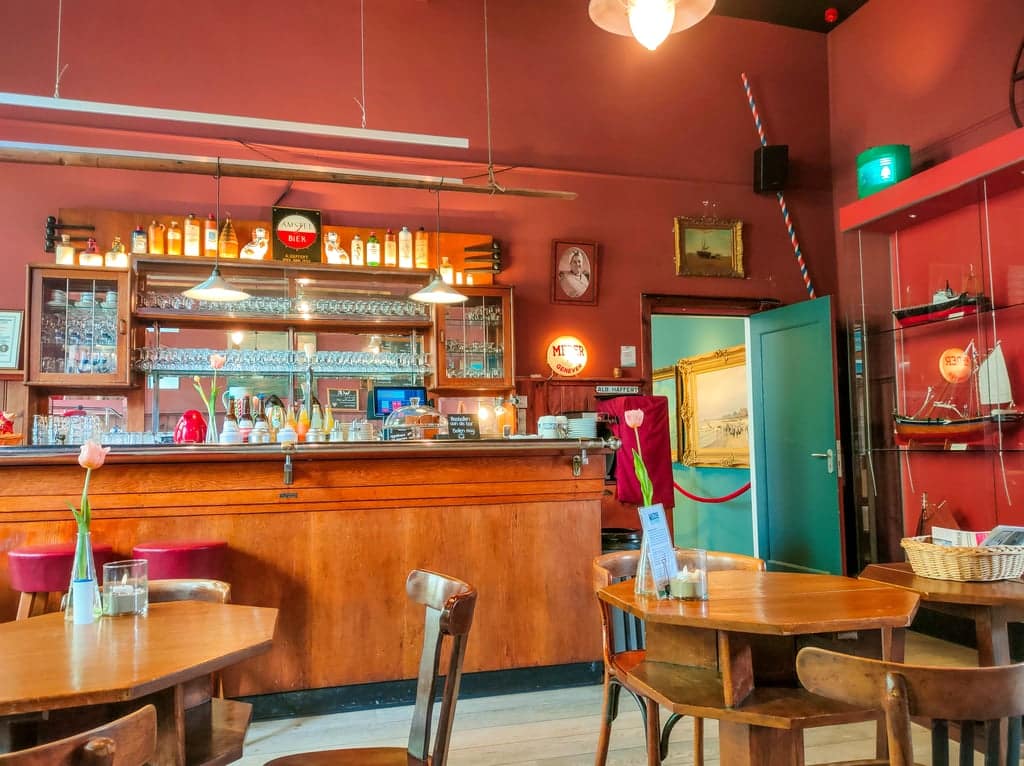
Quite interesting is the museum café De Halve Fleet. It’s a typical ‘bruin café‘ (brown pub) which has existed until the 1970 in Scheveningen and after the death of the owner it was donated to the museum and leads today a second life. It used to be one of the most popular pubs in Scheveningen and today you can enjoy a drink and a lovely lunch.
Practical info
Address: Neptunusstraat 90-92, 2586 GT Den Haag
Admission fee: adults – 10 EUR; kids (13-17 yoa) – 5 EUR
Opening times: Wednesday-Sunday, from 11:00 till 17:00
Website: www.muzeescheveningen.nl
2. See contemporary art in Museum Beelden aan Zee
Beelden aan Zee (Sculptures by the See) is one of the only museums in the Netherlands to specialize exclusively in exhibiting contemporary sculptures. It was founded by Theo and Lida Scholten in 1994, a Dutch couple who were avid collectors of sculptures. You can see some rather impressive artworks at Beelden aan Zee from artists such as Piet Esser, Jaap Kaas, Tony van de Vorst, and Ossip Zadkine.
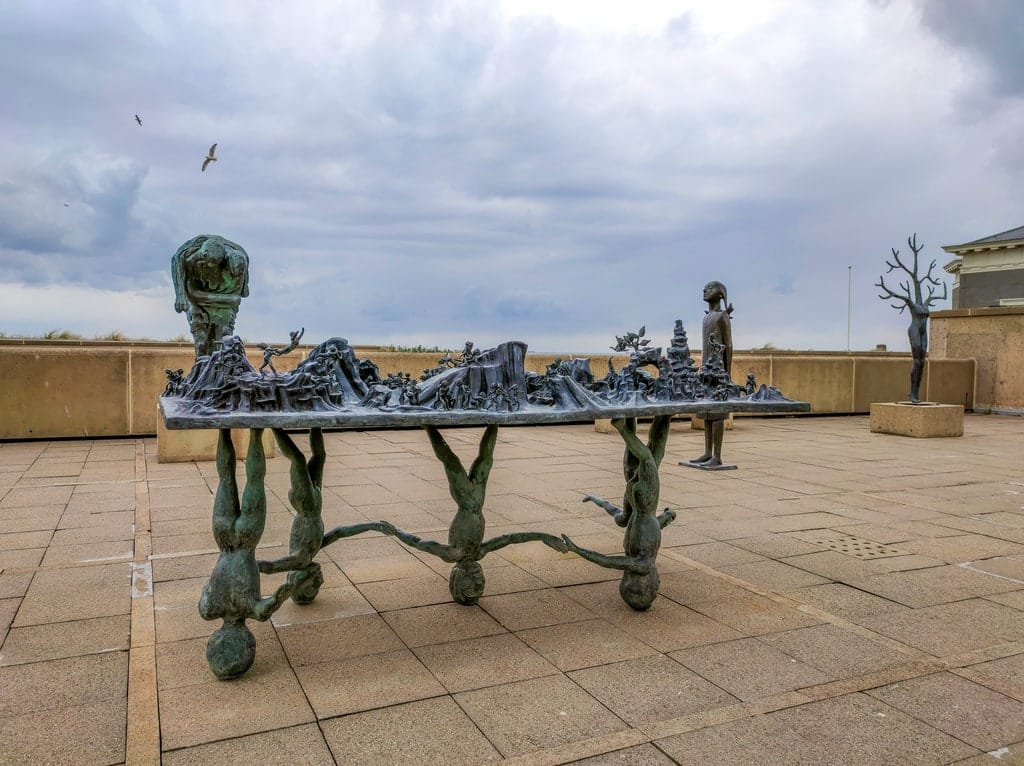
Aside from the permanent exhibits, there are several temporary exhibits in the museum that continuously change, featuring works by both renowned and emerging artists. The diversity of materials used is also amazing: you can see sculptures made from bronze, stone, steel, and glass, among others.
The building where the museum is housed was designed by the Dutch architect Wim Quist (1930-2022). The architecture of the museum is notable for its modern and minimalist design. It’s characterized by clean lines, geometric shapes, and extensive use of glass, which allows ample natural light to filter into the exhibition spaces. The building itself almost becomes a work of art, with its sleek and contemporary aesthetic blending seamlessly with the coastal surroundings.

One of the most striking features of the museum’s architecture is its location partially underground. The main exhibition spaces are housed in a series of interconnected underground galleries, which not only provides a unique experience for visitors but also helps to preserve the natural beauty of the beachfront landscape.
Address: Harteveltstraat 1, 2586 EL Den Haag
Admission fee: adults – 17,50 EUR; kids (13-18 yoa) – 8,75 EUR
Opening times: Tuesday-Sunday, from 10:00 till 17:00
Website: www.beeldenaanzee.nl
3. Stroll along Keizerstraat
Keizerstraat is the oldest and the most famous street in Scheveningen-Dorp (the Village of Scheveningen). It was first mentioned with its name in 1561, although it’s not clear which keizer (emperor) it honors.
Today, Keizerstraat is an emblematic street, known for its charming atmosphere, lined with a variety of shops, cafes, restaurants, and galleries. You can find there mostly independent boutiques and deli-shops.
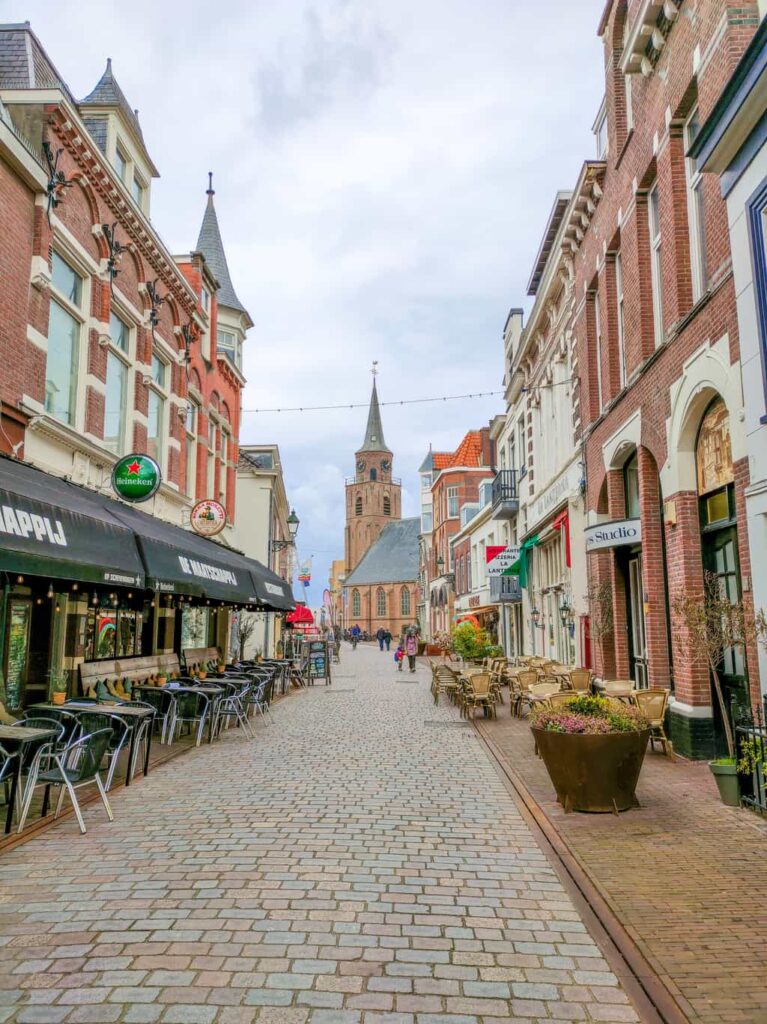
Strolling the street from one end to the other is a favorite thing to do in Scheveningen not only for tourists but also for locals. In the past, this was the place to see (others) and be seen, or how they call it in Dutch ‘flaneren‘. Girls would walk on one side of the street, boys on the other and if you were lucky you might get a wink or catch a blown kiss.
4. Visit the Old Church (Oude Kerk)
At the place where Keizerstraat ends at the sea boulevard, you’ll find Oude Kerk (the Old Church). This church dates back to the 15th century and is the oldest surviving building in Scheveningen. The church has undergone various renovations and restorations over the centuries but still retains much of its original character and charm.
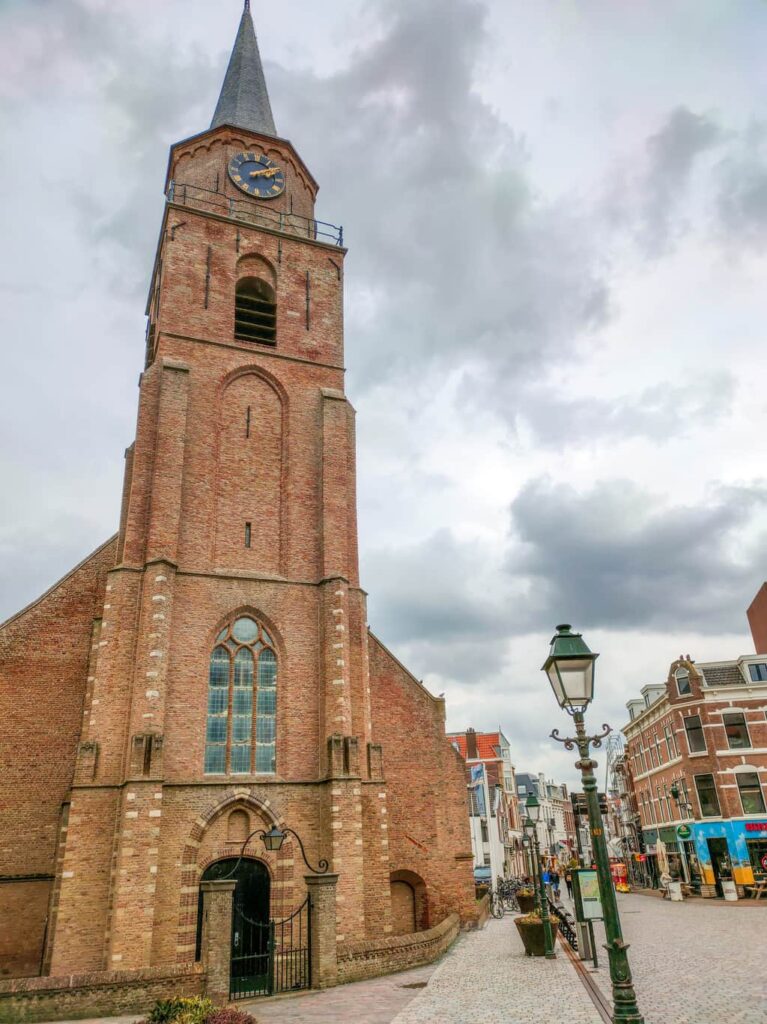
An interesting fact is that in this church exactly, Christiaan Huygens (one of the most prominent figures of the Scientific Revolution) invented the pendulum clock in 1657. This was one of the most remarkable inventions of the 17th century. People no longer had to look at the sun to determine what time it was. They could simply look at the church clock!
Address: Keizerstraat 8, 2584 BJ Scheveningen
5. See The Fisherman’s Wife (Vissersvrouw)
Just above Oude Kerk on the dike you’ll find a quite moving monument: a woman gazing towards the open sea, waiting to spot the boat with her loved ones, who will never return, and the wind blowing her skirts. She symbolizes the waiting, the worrying, and the support provided by the women whose husbands, sons, and fathers braved the dangers of the sea to make a living from fishing.
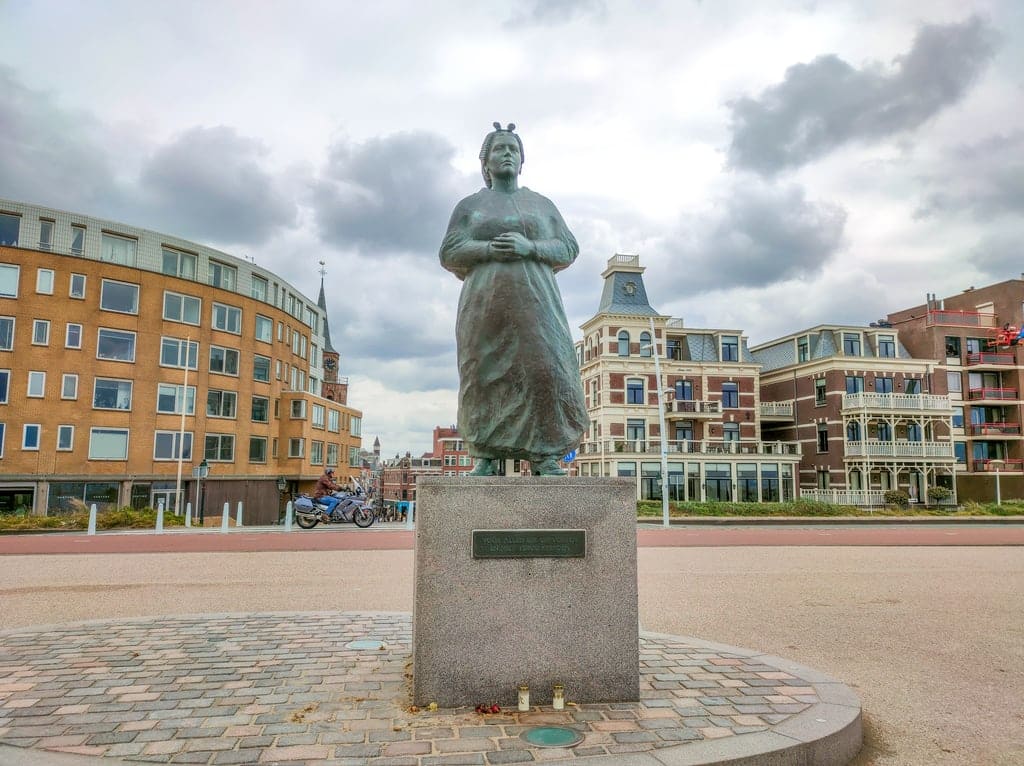
The monument commemorates all those who lost their lives in the sea: not only the fishermen, but also those who were in the Royal Navy and sank with their ships during World War II, for example.
6. Take moment to learn about Dutch history at The Memorial Needle
A bit further from the Fisherman’s Wife there is another important monument in Scheveningen: The Memorial Needle (De Gedenknaald). It commemorates the departure of Prince Willem V in 1795 and the landing of Prince Willem Frederik in Scheveningen on 30 November 1813.
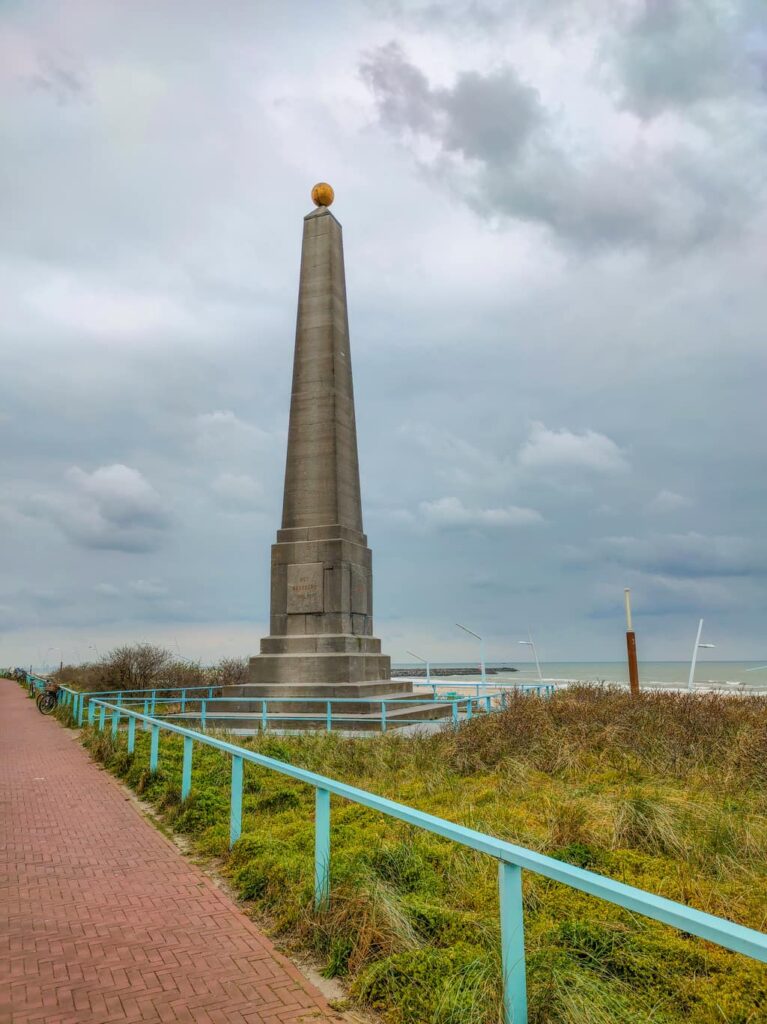
A few days later he would become Sovereign Prince of the Netherlands and will remain in the history as Willem I (William I of the Netherlands), the first king of the modern Kingdom of the Netherlands. The monument was erected in 1865.
7. Look up at The Lighthouse of Scheveningen
The Lighthouse of Scheveningen (De Vuurtoren van Scheveningen) is another iconic landmark in Scheveningen. This historic lighthouse (about 40 m tall) was constructed in 1875 and has since guided ships along the North Sea coastline, aiding navigation and ensuring safe passage for vessels entering and leaving the nearby Port of Scheveningen.
The first lighthouse in Scheveningen, built in the 16th century, was a very simple structure with fire lit up every night. Then the fire gave place to a kerosene lamp and at the beginning of the 20th century to an electrical lamp. The light of the today’s lighthouse can be seen from 29 nautical miles, which is just over 50 km!

On the top of the lighthouse there is mermaid. The legend goes that when the lighthouse was built the residents of Scheveningen asked the architect to put a mermaid on the top of it, so that the merman could see from a distance that the mermaid is safe in Scheveningen. Somewhere is Zeeland, in Westenschouwen, the fishermen had caught a mermaid and her husband, the merman, got so furious that he destroyed the whole village. The people of Scheveningen didn’t want this to happen to their place, so they placed a mermaid on the top of the lighthouse.
8. Feel the vibe at The Harbour of Scheveningen
The Harbour of Scheveningen is a bustling hub for fishing, tourism, and maritime activities. Scheveningen has a long history as a fishing village, and fishing remains a vital part of its economy. It is one of the largest fishing ports in the Netherlands, with a fleet of trawlers and fishing vessels that venture into the North Sea for various catches, including herring, mackerel, sole, and plaice.
Scheveningen is renowned for its Fish Auction (Visafslag), where freshly caught seafood is brought ashore and sold to wholesalers, retailers, and exporters. The auction is a significant event in the local fishing industry and attracts buyers from across the region.
If you are a seafood lover, the Harbour of Scheveningen is the best place to sample the catch of the day. There are many restaurants around the port and you won’t be disappointed whichever you choose. Fish can’t get any fresher than this!
The port is also the place where the boat tours depart:

9. Gather some stardust at Kurhaus
Another iconic building in Scheveningen is the Kurhaus – one of the most famous hotels in the Netherlands! Originally built in 1885, the Kurhaus was intended to be a luxury spa resort, catering to wealthy visitors seeking the therapeutic benefits of sea bathing and relaxation. The grand hotel quickly gained popularity among European aristocrats, royalty, and celebrities, attracting guests from around the world.
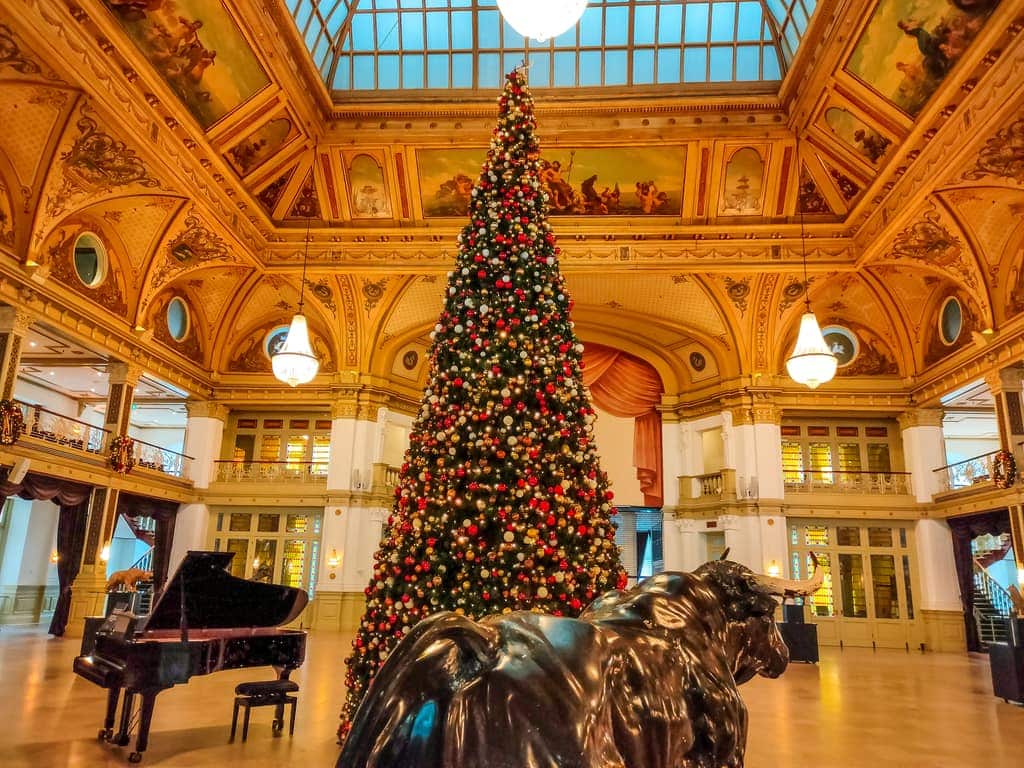
In the 1960s and 1970s the Kurhaus was a popular concert venue and no other than Rolling Stones and Tina Turner, among others were seen there for the first time in the Netherlands!
Over the years, the Kurhaus has undergone several renovations and expansions to modernize its facilities and accommodate changing tastes and preferences. Today, it continues to operate as a five-star hotel – Grand Hotel Amrâth Kurhaus The Hague, offering luxurious accommodations, fine dining restaurants, elegant event spaces, and world-class amenities.

10. Take a bird-eye-view of Scheveningen on the SkyView De Pier
SkyView de Pier is definitely one of the attractions in Scheveningen that is not to be missed! Towering 50 meters above the North Sea, the giant Ferris wheel offers unparalleled views of Scheveningen beach, the sea, and the nearby neighborhood.
A full rotation trip takes around 12 to 15 minutes, during which time you will be housed in a luxurious gondola and can even share a unique high tea with friends and family.
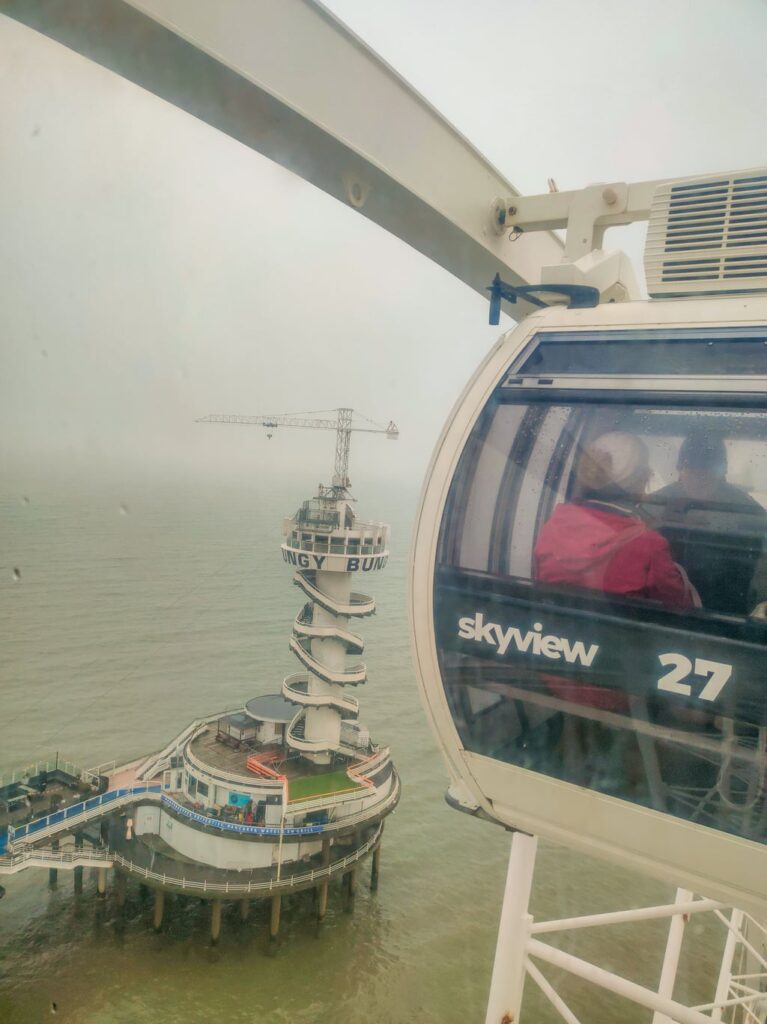
De Pier itself is also nice to stroll along all year round with various food vendors and places to relax. And why even not spend the night in one of the luxurious suites at the end of the pier overlooking the open sea.
Practical info
Address: Strandweg 156 2586 JW Scheveningen
Admission fee: including a drink: adults – 15 EUR; kids (up to 12 yoa) – 7,50 EUR; only the Ferris Wheel: adults – 10,50 EUR
Opening times: Monday-Thursday, from 12:00 till 20:00; Friday-Saturday, from 11:00 till 22:00; Sunday, from 11:00 till 21:00
Website: skyviewdepier.nl
11. Visit SeaLife Scheveningen
SEA LIFE Scheveningen is one the best attractions in Scheveningen for anyone interested in sea fauna and flora. There are 45 aquariums that accommodate an array of sea life from fish, sharks, rays, and even Max the Asian small-clawed otter. With more than 4,000 species of marine life, your visit to SEA LIFE Scheveningen will be nothing short of amazing.

As a bonus, you will be able to contribute to the Sea Life trust, an organization that has been set up in order to protect the world’s oceans. Not only will you be able to see this beautiful marine life at Sea Life, but also ensure that the natural marine habitats of these animals are conserved.
Practical info
Address: Strandweg 13, 2586 JK Den Haag
Admission fee: adults – 21 EUR; kids (up to 3 yoa) – free of charge
Opening times: daily, from 10:00 till 17:00
Website: www.visitsealife.com
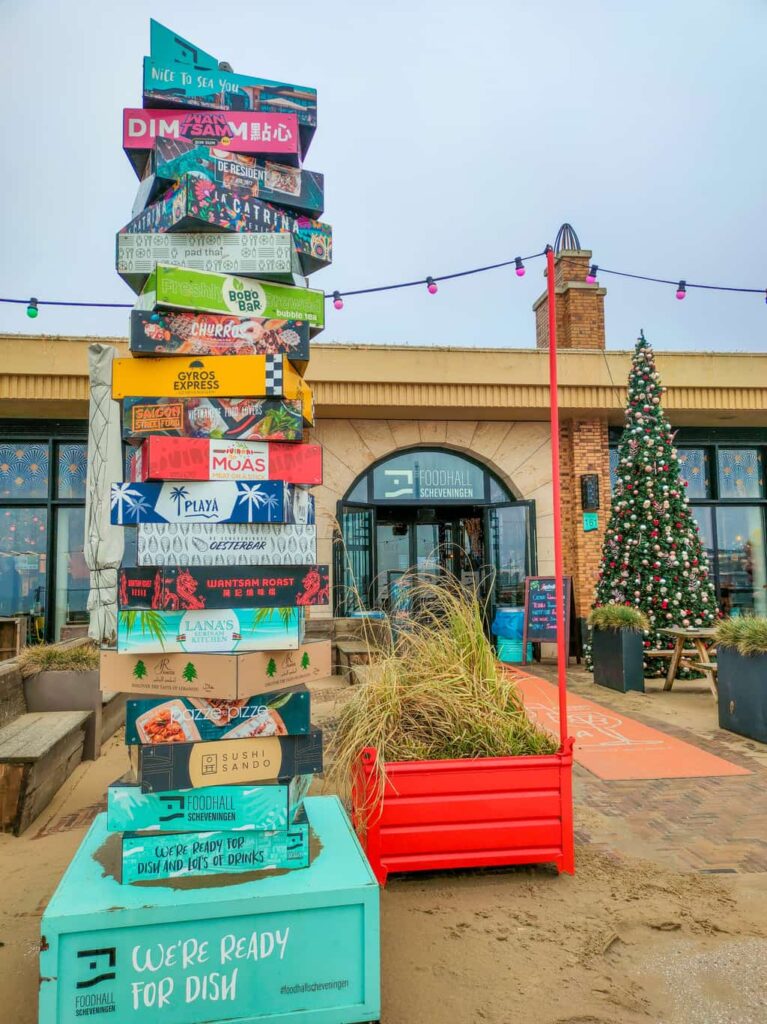
12. Taste some world dishes at The Foodhall
The Foodhall is the newest hotspot in Scheveningen. It has been inspired by the atmosphere of a lively, cosmopolitan market full of lights and sounds and it features 16 world-kitchen restaurants. From Spanish churros to Saigon street food, and Thai snacks, you can find it all there. Even in off-season the place is lively and full of charm.

I went to the Foodhall with a group of travel bloggers and journalists in the days before Christmas and I enjoyed both the atmosphere and the food. The event was organized by The Tourism Bureau of The Hague.
Address: Strandweg 161, 2586 JM The Hague
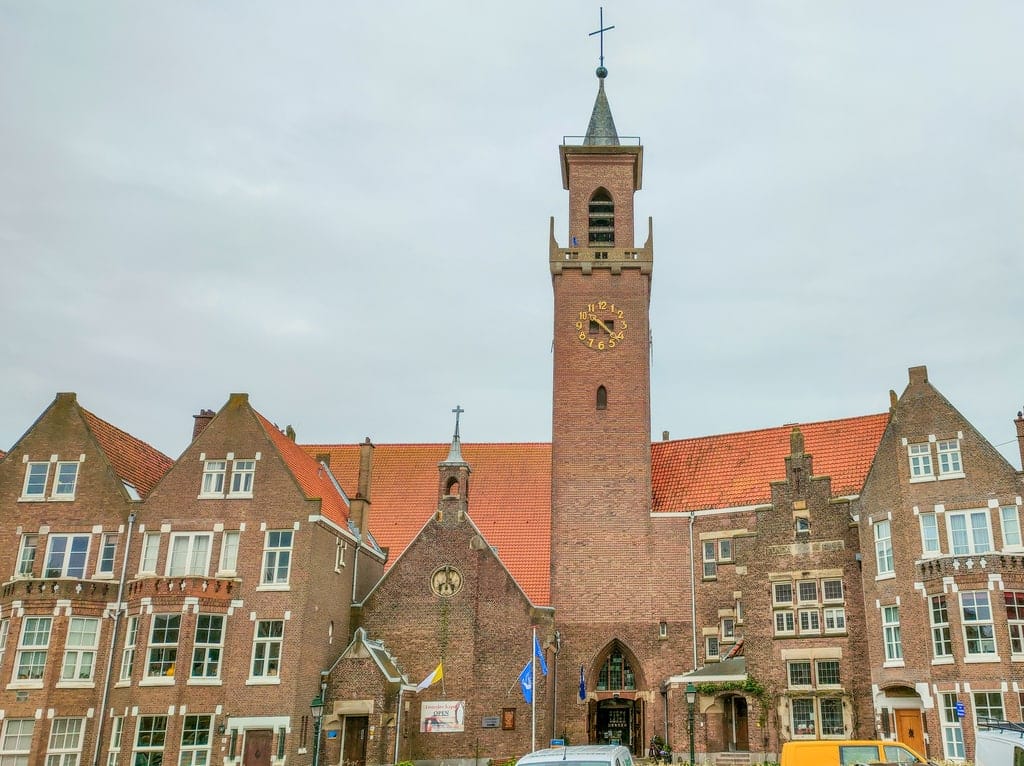
13. Visit Our Lady of Lourdes Chapel
Our Lady of Lourdes Chapel (O. L. Vrouw van Lourdeskerk), built in the 1920s, is a very interesting church in Scheveningen. The chapel area behind the altar houses a copy on a scale of 1:13 of the grotto at Lourdes (Southern France) where Virgin Mary is said to have appeared to Bernadette Soubirous in 1858. A piece of rock from the cave in Lourdes has been cemented under the statue of Our Lady of Lourdes.
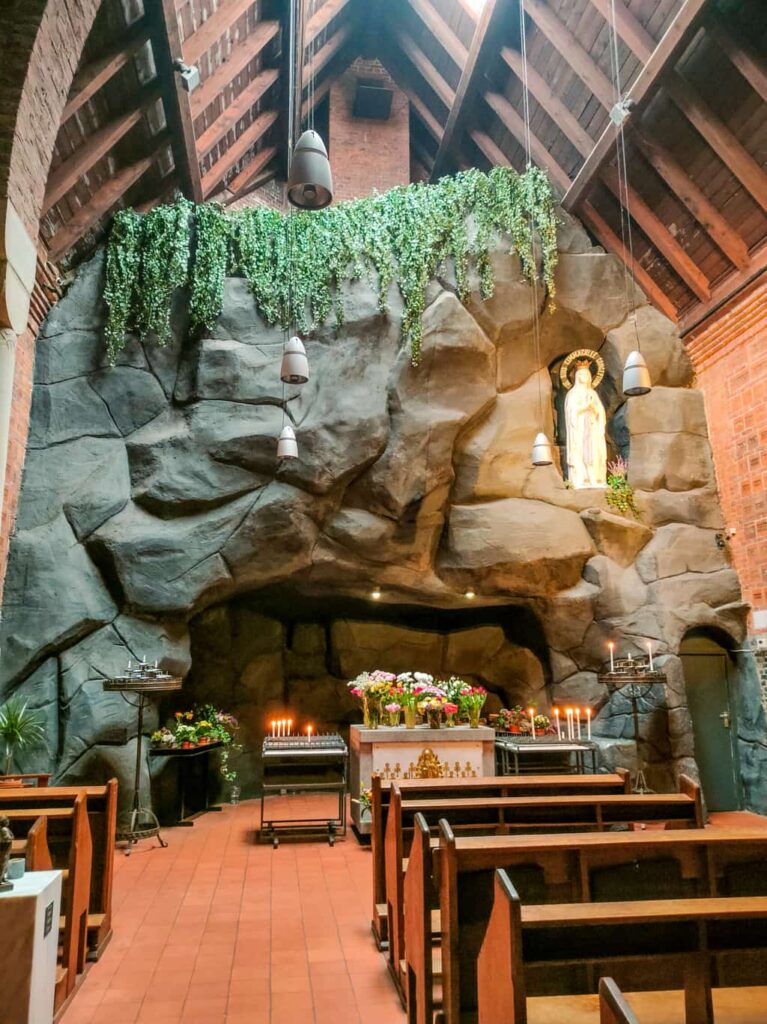
I thought the place of the church was quite interesting, just in the middle of row with houses, blending with the surrounding. It turned out that the whole complex was designed by Alexander Kropholler, a famous architect known as the most famous representatives of the Traditionalist School in the Netherlands.
Address: Berkenbosch Blokstraat 9, 2586 HD The Hague
14. Go for a walk in Oostduinpark or Westduinpark
On either side of Scheveningen you will find a lovely park to walk alongside sandy dunes and enjoy the nature.
From the high dunes in Oostduinpark there’s an amazing view of the sea, Scheveningen and even The Hague. You can spot Luchtwachttoren 5C1 – one of the 279 air watch towers built in the Netherlands during the Cold War.
The Westduinpark is a protected nature area characterized by dense forests, open plains, and high dune tops. You can even meet there Scottish highlanders roaming freely. The park stretches all the way to the next town on the coast – Kijkduin.
15. Visit the Atlantic Wall Museum
During WW2 the coastline of the Netherlands was part of the Atlantic Wall and there were built many bunkers along the shore. The Atlantic Wall Museum in Scheveningen has 2 locations which you can visit and learn about the this period of Europe’s history.
A great part of the commando bunker on Badhuisweg is original with preserved authenticity. It’s what would be a type 608 bunker (Bataillons, – Abteilungs-oder Regiments-Gefechtsstand) of the occupying forces. Original historical artefacts from German, British, Canadian and American armed forces are also on display in the museum.
Practical info
Address: Widerstandsnest 318 (Badhuisweg 119-133, 2597JM, Scheveningen) and Widerstandsnest 67 HL (Deltaplein 200, 2554 EJ, Kijkduin)
Admission fee: adults: 8 EUR; kids (under 12 yoa): 2 EUR
Opening times: Badhuisweg location: from 5 May till 27 October, daily, from 10:00 till 16:00; Kijkduin: in 2024 only open on 7/07, 4/08, 1/09, and 6/10 due to renovations
Website: www.atlantikwallmuseum.nl
16. If you travel with kids, go to LEGOLAND® Discovery Centre
Scheveningen is a kids-friendly destination, even in the shoulder season. The indoor Lego paradise LEGOLAND® Discovery Centre would be the perfect stop for a couple of hours if it’s rainy or cold outside. I’m sure adults would love it, too!
Kids can play there with Duplo, LEGO Ninjago ™ and LEGO Friends ™. There is a 4D cinema with fun LEGO films and an exciting attraction ride through a beautiful LEGO city. MINILAND® with famous landmarks from The Hague built in thousands of LEGO bricks is also not missing.
Practical info
Address: Strandweg 13 K, 2586 JK Den Haag
Admission fee: 20-25 EUR depending on the day/time slot
Opening times: daily, from 10:00 till 17:00; school holidays: daily, from 9:30 till 18:00
Website: www.legolanddiscoverycentre.com
Is it worth visiting Scheveningen in low season?
I personally prefer visiting Scheveningen in low season. You don’t have the crowds with tourists and yes, Scheveningen is very crowded in the summer, especially during the school holidays. All those kiosks selling anything and everything on the boulevard are gone in low season and place is very peaceful to walk around and to relax.
On the other hand Scheveningen is not only a resort, it has some world-class museums (Beelden aan Zee and Muzee), as well as all other attractions are open all year round. So if you want to escape the crowds and pay less for accommodation, than visiting Scheveningen in the low season is a very good idea.
So whenever you happen to be in The Hague, just hop on the tram and go to Scheveningen. In the next chapter you will find more information how to get there.
How to get to Scheveningen?
As Scheveningen is actually part of The Hague, it is very easy to reach. However, you will first need to get to The Hague. The Hague on its turn is well-connected to the rest of the country both by highways and public transport.
If you are travelling by car, you can park along the beach on Strandweg, or in one of the parking garages. However, in the summer or at the weekend it might be difficult to find a spot. Then you can use the so-called service Park+Beach, where you park somewhere in The Hague and then you use the public transport to get to the beach.
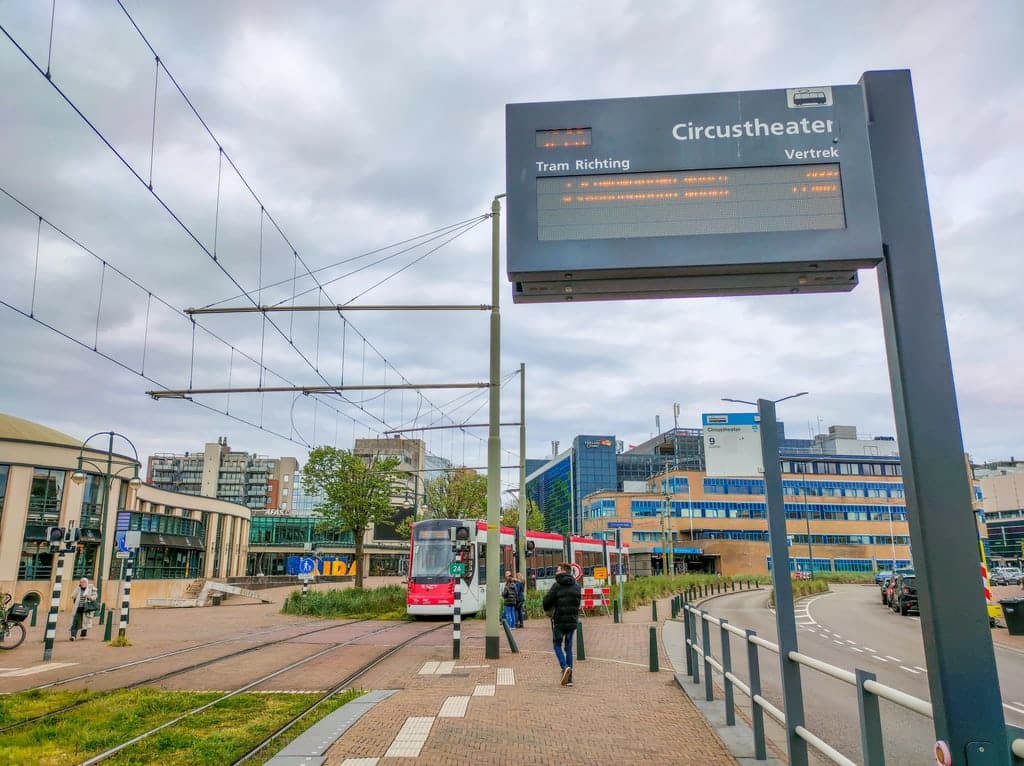
From Den Haag Centraal (The Central Railway Station in The Haag) you can take tram line 9 to Scheveningen Noord. The trip is less than 15 minutes. Also tram lines 1, 11 and 12 connect The Hague with Scheveningen.
I have visited Scheveningen and The Hague many times both by car and by public transport. I would advise to choose for public transport as it’s quick, reliable and more sustainable than using a car. Also on a warm day there might be terrible traffic jams on the highways towards the seaside.
Is it in Scheveningen or on Scheveningen?
How do you know if someone is a local? It’s simple, when talking about their place, they would say ‘on Scheveningen’ (op Scheveningen in Dutch) instead of ‘in Scheveningen’ (in Scheveningen in Dutch). Just like in English, in Dutch, as well, you would use “on” for an island and “in” for a city or town.
But why would locals say ‘on Scheveningen’? Historically, ‘on’ would be used until the 18th century to indicate that a place is located significantly higher above the sea level. And that’s how it had remained in the local dialect.
