
When I arrived in Palma, I didn’t know what to expect. One thing for sure, Palma surprised me with its beautiful architecture. There’s one particular architectural style that fascinates me a lot and this is Art-Nouveau. So, the first thing I did when I arrived in Palma, is find all Art-Nouveau buildings in the city, read about them and then visit them. And this is how this guide to the Art-Nouveau (Modernista) architecture in Palma was born. Read further to find out which are the most beautiful Art-Nouveau buildings in Palma de Mallorca, where to find them and what their history and particularities are. This post also includes a handy map with the exact location of the buildings.
DISCLOSURE: This post contains affiliate links. If you make a purchase via one of those links, I will earn a commission at no extra cost for you.
What is Art Nouveau?
Towards the end of the 19th century Europe was in a desperate need of something new, a new form of art that would break up with the norms of the old century and will welcome the euphoria of the new one. A new art was born which introduced rounded shapes, curvilinear forms, whiplash lines and nature-inspired motifs. The so-called Art Nouveau (‘new art’) quickly spread around Europe and found expression in almost everything, from architecture to jewelry, from graphic art to furniture.
Regional influences around Europe enriched the Art Nouveau movement and contributed to its specific local charm. Thus, Modernism appeared in Catalonia, Jugendstil in Germany, Secession in Austria, Stile Liberty in Italy, Nieuwe Kunst in the Netherlands.
Read more:
Fascinated by Art-Nouveau architecture? Read my post about the most amazing examples of Art-Nouveau architecture in Europe.
Planning a trip to Palma? Find out which are the best attractions in Palma de Mallorca.
What is Catalan Modernism?
Modernism (Modernisme in Catalan) is the Catalan answer to the fin-de-siècle cultural movements in Europe. It was born out of the revival of the Catalan identity and nationalism and found expression in art, literature and architecture, with architecture being its most remarkable outlet. Although the cradle of Catalan Modernism is Barcelona, the architectural style spread all over the rest of the Iberian Peninsula and reached the Balearic Islands.
Fun fact: Catalan Modernism (Modernisme) shouldn’t be confused with Modernism, which is a 20th century art movement with representatives like Henri Matisse, Pablo Picasso, and Piet Mondrian.
Modernism in Mallorca
Modernism arrived in Mallorca through the most prominent Catalan architects of the movement: Gaudí, Domenech i Montaner, Rubió and Raspall. They have been commissioned for different projects and they brought their ideas and inspiration with them to the island. Palma, Sóller and Lluc were the most important Modernist centers in Mallorca. The rapid economic development on the island, the industrialization and the rise of tourism, led to the quick spread of those innovative architectural expressions.
The generation of talented Mallorcan architects like Gaspar Bennàssar i Moner, Jaume Alenyar i Ginard, and Francesc Roca i Simó, although predominantly influenced by the Catalan movement, took also inspiration in other international movements like Historicism (Gothic Revival or Neo-Mudéjar). In their works we can also find influences of the French and Belgian Art Nouveau, with undulating and floral forms, as well as Austrian Secessionist elements, with more rectilinear forms and with a clear tendency to geometrisation.

Art-Nouveau walking tour of Palma
When researching where to find the most beautiful Art-Nouveau buildings in Palma de Mallorca, I had a real hard time. There were lists with places and addresses, but then I needed to keep the addresses somewhere, copy-paste them in Google maps, try to find which one is closest to my location… I was totally frustrated.
I wished I had this map I’ve created for you! You can save it in MyMaps and even use it offline. It will spare you all the hassle to locate the buildings and you won’t need to follow a special itinerary. Just open the map when you are walking around, find the nearest building and enjoy it!
Most of the Art-Nouveau architecture in Palma is located in the city centre between Plaça Mayor and the Cathedral. There are a few lovely buildings, just outside the Old Town, like Can Maneu and Can Segura.
In the Santa Catalina and El Jonquet neighborhoods, there are also some beautiful examples of Modernista architecture like La Central hardware store, Can Pujol, Can Palmer, and Hostal Cuba.
The best examples of Modernist Architecture in Palma
So, here they are the most beautiful examples of the Art-Nouveau architecture in Palma! Well, these aren’t the only ones, though. I have found some lovely Art-Nouveau buildings along La Rambla and in the Old Town, but then I couldn’t find any information about their architect or history, so I didn’t include them in this post.
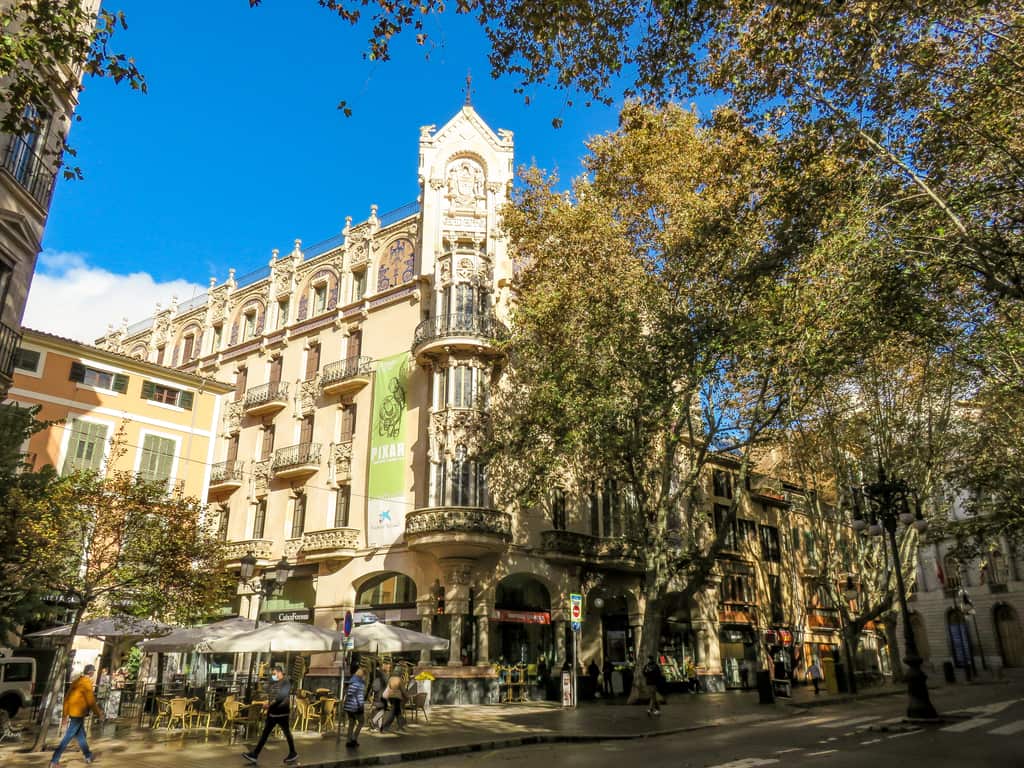
Gran Hotel
Architect: Lluís Domènech i Montaner
Year: 1903
Address: Plaça de Weyler 3, 07001 Palma, Illes Balears
Gran Hotel is perhaps one of the most iconic buildings in Palma and a beautiful example of the Modernist architecture. It was designed by Lluís Domènech i Montaner, one of the most influential architects from the Catalan Modernism. When the hotel opened its doors in 1903, it was the chicest place to be in Spain. It laid down the foundations for the development of the tourism on Mallorca. At the time the hotel was pure luxury. It had a lift, running water, and electricity.
Glazed ceramics, wrought iron, ornamental stuccoes, and capitals with flower ornaments in Mozarabic style adorn this elegant building, making it to stand out among the rest of the houses on Plaça Weyler.

Both the Spanish Civil War and World War II brought the development of the tourist industry on Mallorca to a halt and in 1942 the once glorious Gran Hotel, closed its doors for good. In the 1940s the building was acquired by the Spanish State and housed the National Social Security Institute. The building was renovated in a disastrous way, which basically wiped out most of its Art-Nouveau elements and all of its charm.
In 1993 the Institute moved to another building, and Gran Hotel was acquired by the Bank La Caixa, which restored the building to its previous glory and turned it into a cultural centre for hosting exhibitions, concerts and conferences.
Practical info:
Admission fee: 6 EUR
Opening times: Monday-Sunday, from 10 am till 9 pm

Forn des Teatre
Architect: unknown
Year: 1916
Address: Plaça de Weyler 9, 07001 Palma, Illes Balears
Just across the street from Gran Hotel is another jewel of the Catalan Modernism – Forn des Teatre. This is perhaps one of the most photographed façades in Palma and for a reason. The building itself was built in the 19th century but the façade of the bakery shop established by Jaume Alemany was executed in the fashionable Art-Nouveau style with curvy lines and floral motifs. The bakery was named Forn des Teatre because of its proximity to Palma’s major theatre – Teatre Principal.
The new owners of the bakery – Fornet de la Soca, continue the tradition established by Mr Alemany, turning the bakery again in a beloved place where you can try the famous ensaïmadas, among other treats.

Edifici Casasayas / Can Casasayas & Pensión Menorquina
Architect: Francesc Roca i Simó
Year: 1908-1911
Address: Plaça del Mercat 13 & 14, 07001 Palma, Illes Balears
These twin buildings located on the opposite side of Plaça del Mercat are another remarkable example of the Modernist architecture in Palma. The left building (Can Casasayas) was commissioned by the master confectioner Josep Casasayas Casajuana, owner of the ‘Can Frasquet‘ bakery. Casasayas came from Catalonia to Palma at the end of the 19th century.
Francesc Roca i Simó, a great admirer of Gaudí, was the architect of the first of the buildings – Can Casasayas (1908-1910). It was designed as a residential building with 4 floors and a commercial space on the ground floor. The second building, the former Pensión Menorquina, across the tiny street Carrer Costa de Santacília, is absolutely identical and symmetrical to Can Casasayas. It was finished between 1909 and 1911 by the architect Guillem Reynés.
The influence of Gaudí can be seen in the wavy façade, which reminds of his Casa Battló and Casa Milà in Barcelona. Again wrought iron, floral motifs and butterfly shapes adorn the façade. The visual dynamism and plasticity are achieved by the undulated balconies and the parabolic arches. Noteworthy are the shutters, which are in typical Mallorcan style.

Can Forteza Rey
Architect: Josep Forteza Rey
Year: 1902-1911
Address: Plaça del Marquès del Palmer 1, 07001 Palma, Illes Balears
After Plaça del Mercat head to Plaça del Marquès del Palmer for another set of beautiful Art-Nouveau buildings. Can Forteza Rey is a real eye-candy. There are a few question marks regarding the year when the building was finished and its architect. Most likely the building was designed or greatly influenced by its developer – the goldsmith José Forteza-Rey and was built somewhere between 1902-1911. It was intended as a residential building for the Forteza-Rey family. The 2nd floor housed the dental clinic of one of the Forteza-Rey sons – Ignacio.
The façade of the building is strongly influenced by the Gaudí‘s style of using broken tile mosaics, the co-called ‘trencadís‘, and wrought iron for the balcony railings. The ceramic tiles used for the façade came from the famous Mallorcan factory ‘La Roqueta‘.

Almacenes El Águila
Architect: Gaspar Bennàssar i Moner
Year: 1908
Address: Plaça del Marquès del Palmer 2, 07001 Palma, Illes Balears
Next to the Can Forteza Rey is standing another excellent Art-Nouveau example – the building of the former department store El Águila. Architect of the building is Gaspar Bennàssar i Moner – perhaps the most influential architect in Palma, who was the city’s chief architect from 1901 to 1933.
Almacenes El Águila, although also in Art-Nouveau style, is quite distinct from the adjacent Can Forteza Rey. El Águila follows the aesthetics of the Vienna Secession movement, while Can Forteza Rey is reminiscent of Catalan Modernism and Gaudí. It’s quite fascinating to look at these two buildings, representing two different Art-Nouveau schools. They are a good example of the different directions the Catalan and the Austrian versions of this architectural style took.
Today, there’s a footwear store on the ground floor and hotel suites on the rest of the floors in the building.

Can Cetre (Can Forteza)
Architect: unknown
Year: 1904
Address: Carrer de la Bosseria 3, 07001 Palma, Illes Balears
Just across the street from Can Forteza Rey, at Carrer de la Bosseria 3, a short street connecting Carrer de Colom with Carrer del Sindicat, is located another lovely Art-Nouveau example – Can Cetre, also known as Can Forteza. The ceramics are from the famous factory La Roqueta. Owner of La Roqueta (1897-1918) was Pere Joan Aguiló Forteza, nicknamed ‘Cetre’. He also owned the bakery at number 6 in the same building – Forn de Can Cetre.

Can Roca
Architect: Francesc Roca i Simó
Year: 1907
Address: Carrer de Sant Nicolau 20, 07001 Palma, Illes Balears
Can Roca was one of the first Art-Nouveau buildings of the famous local architect Francesc Roca i Simó. It was built in 1907 and shows influences of the Secession, which is characterized by straight lines and decorative schematism. Later on in his career Francesc Roca i Simó will depart from the Secession, to embrace the Catalan Modernism, visible in his masterpiece Can Casasayas (1908-1910).

Can Corbella
Architect: Nicolau Lliteres
Year: end of the 19th century
Address: Plaça de Cort 6, 07001 Palma, Illes Balears
Can Corbella is not strictly built in Art-Nouveau style, but in Neo-Mudéjar which was quite popular towards the end of the 19th century and heavily influenced the Catalan Modernism. Architect of the building is Nicolau Lliteres. Actually, these were three buildings joined by a unique wooden facade which makes them look like a single building.
The facade of Can Corbella features wooden pillars between the arched windows and the ground floor has amazing multi-coloured stained-glass windows framed by horseshoe arches. Above the windows there are beautifully painted plaques representing the guild associations of craftsmen and merchants in Palma at the end of the 19th century. To see the last floor of the building you need to look at it from a distance, as the top floor is slightly set back. The building is crowned by an octagonal tower.
When the facade was finished, on the ground floor of the building there was the pharmacy Corbella, which gave the name of the building. The pharmacy closed its doors in 1985. Afterwards Real Madrid had its fan store there, and today there’s housed the adorable bakery Fornet de la Soca. Actually, this is the 2nd bakery in town of Tomeu Arbona, who’s first bakery is housed in the iconic Forn des Teatre.

Can Barceló
Architect: Bartomeu Ferrà
Year: 1902-1904
Address: Plaça de Quadrado 9, 07001 Palma, Illes Balears
Can Barceló is another iconic building in Palma in the Art-Nouveau style featuring ceramic tiles from the famous factory La Roqueta. Architect of the building is Bartomeu Ferrà Perelló (1843-1924), who was a representative of the Catalan Renaissance cultural movement (“La Renaixença”). The stunning tiles on the facade were designed by Vicenç Llorens, a local draftsman. The building, finished in 1904, was commissioned by the local textile merchant Bartomeu Barceló Mir and was built on the site of a former weaving mill.
The beautiful tile panneaux represent stylized allegories of the arts, crafts and economy and feature textile crafts, pottery, science, architecture, music, painting and trade.

Caja de Ahorros y Monte de Piedad de las Baleares
Architect: Gaspar Bennàssar i Moner
Year: 1904-1906
Address: Carrer de Ramon Llull 2, 07001 Palma, Illes Balears
In 1903, the savings bank ‘Sa Nostra‘ (Caja de Ahorros y Monte de Piedad de las Baleares) commissioned the architect Gaspar Bennàssar to design a modernist building for its headquarters, on Ramón Llull Street in Palma. The building was inaugurated in 1909. Sa Nostra building, although still featuring modernist elements, has more eclectic appearance. During its last renovation a lot of the original elements were not restored and the building lost some of its original character.

Can Coll
Architect: Gaspar Bennàssar i Moner and Jaume Alenyar i Ginard
Year: 1906-1907
Address: Plaça de la Llotja 3, 07001 Palma, Illes Balears
Located at one corner of the lovely Llotja square, is another beautiful modernist building – Can Coll. The building for Maria and Catalina Coll was a joint project of Gaspar Bennàssar i Moner and Jaume Alenyar i Ginard.
Can Maneu (Bar Triquet)
Architect: Gaspar Bennàssar i Moner
Year: 1909
Address: Carrer del Sindicat 74, 07001 Palma, Illes Balears
Can Maneu was built in 1909 for the industrialist Joan Oliver Florit (Maneu) and designed by no other than Gaspar Bennàssar i Moner. The floral decorations of the windows and the capitals, as well as the overall dynamism, are quite reminiscent of the Gran Hotel.
Soon after the construction of Can Maneu was finished, on the ground floor there opened its doors Bar Triquet, one of the most popular meeting points in Palma. The bar however didn’t survive the present day and was closed in 2018. In the last years the building was beautifully restored to its previous glory.
Can Segura
Architect: Francesc Roca i Simó
Year: 1908
Address: Avenida del Comte de Sallent 2, 07001 Palma, Illes Balears
Can Segura is located in the heart of Palma, on the corner of Avenida Conde Sallent and Calle 31 de Diciembre. Architect of the building is Francesc Roca i Simó. The beauty of the building lies in its simplicity and in the straight lines. The verticality of the lines is accentuated by the false columns and the symmetrical elements show influence of the Vienna Secession.

Ferretería La Central (Ca don Pau)
Architect: unknown
Year: 1908
Address: Carrer de Sant Magí 37, 07001 Palma, Illes Balears
This lovely building is located in the neighbourhood El Jonquet. It’s believed that the architect who built it was a pupil of Gaudí, but his name remains unknown. There are speculations that Jaume Alenyà i Ginart is the architect, because of his friendship with the Palmer Moreys, who were the first owners of this property, which before being a hardware store, also housed a butcher shop and a store.
Pau Gelabert i Calafell opened in 1908 a hardware store on the ground floor under the name Ca Don Pau. They were selling hardware, gardening tools, and products for fishermen and sailors. Gelabert’s nephew, Francisco Sampol, continued with the business and later transferred it to Gabriel Serra.
The façade of La Central stands out for its wrought iron decorations and the slightly undulating shapes. It features beautiful stone corbels decorated with flowers and horns-of-plenty, which most likely are an allegory of the desired prosperity for the business that was to be housed in the property.
Can Pujol
Architect: Gaspar Reynés i Coll and Jaume Alenyar i Ginard
Year: 1904
Address: Carrer de Pou 24, 07001 Palma, Illes Balears
Can Pujol is located in the Santa Catalina neighbourhood. It’s a beautiful town house designed by the architects Gaspar Reynés i Coll and Jaume Alenyar i Ginard. The façade is gorgeously decorated with stone ornaments with floral and vegetable motifs, located in the lintels of the windows.
In the last years the house was bought by a German investor and was beautifully restored preserving the original Modernist elements. For a while it was a bed-and-breakfast.
Casa Joan Oliver Florit
Architect: Gaspar Bennàssar i Moner
Year: 1910
Address: Avinguda d’Alexandre Rosselló 7, 07001 Palma, Illes Balears
The house for the industrialist Joan Oliver Florit was designed by Gaspar Bennàssar i Moner in collaboration with Jaume Alenyar i Ginard. The facade features historical elements, like the miradors, executed in an exquisite Modernist style with some Secession influences.

Catedral de Mallorca (la Seu)
Architect: Antoni Gaudí i Cornet
Year: 1904-1915
Address: Plaça de la Seu, 07001 Palma, Illes Balears
The Cathedral of Palma (or La Seu in short) is the most popular site on the Balearic island of Mallorca. It stands proudly atop a hill in the Old Town, overlooking the sea and bathing in the setting sun. The construction of the cathedral started in the 13th century but it wasn’t finished until 1630.
In 1901 the then bishop of Mallorca Pere Joan Campins i Barceló invited Antoni Gaudí to work on the restoration of the cathedral. Gaudí suggested some drastic changes like removal of the two altarpieces that were blocking the view to the bishop’s throne, and placing a canopy above the altar. In 1914, after a quarrel with his contractor, Gaudí abandoned the project, which was officially terminated after the death of the bishop in 1915.
